
Almonds • Oil format • Specs-first sourcing

Bulk Refined Almond Oil

Atlas Nut Supply, LLC supplies bulk refined almond oil to manufacturers, brands, and distributors. We cooperate with multiple California suppliers to align the right quality parameters, packaging, documentation, and delivery lane for your procurement.

Refined almond oil is typically selected when buyers need a cleaner sensory profile (low odor), repeatable QA targets, and dependable supply in industrial packaging. Most programs are qualified by measurable limits like acid value/FFA, peroxide value, moisture & volatiles, and color—plus filtration/clarity requirements for your process.

Format
Refined almond oil
Programs
U.S. + global export
Support
COA • traceability • docs

Request a quote View specs Back to catalog

Fastest quoting: share your acid value/FFA and peroxide targets, color/odor expectations, packaging (drums or totes), monthly volume, and destination (and port if export).
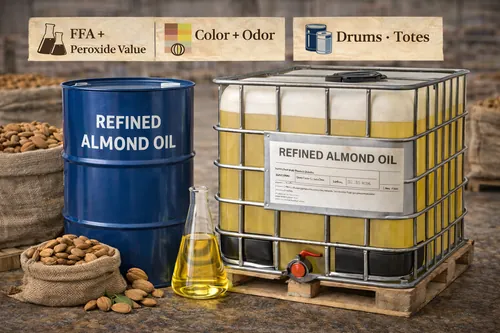
Packaging: drums • totes Optional: filtration/clarity Optional: inert gas handling
Bulk Refined Almond Oil for wholesale supply — Atlas Nut Supply

Why buyers choose refined almond oil

Refining is used to improve consistency and reduce variability—especially important for larger-scale production. While every program is qualified to the customer’s spec, refined oil is commonly selected for:

  • Cleaner sensory profile: lower odor/volatile notes than many unrefined oils (program dependent).
  • Process-friendly performance: clearer oil helps with pumping, dosing, and filtration-sensitive systems.
  • Specs-first procurement: measurable QA parameters support supplier qualification and repeatability.
  • Industrial packaging: drums/totes align to manufacturing receiving and batching operations.

Need other almond oil formats? See cold-pressed edible almond oil or crude almond oil. For a nut-oil alternative, consider refined walnut oil.

Refined almond oil program options

Common variables (availability varies by season and supplier program):

  • Program type: refined / deodorized; some lanes support organic or specific compliance targets (program dependent).
  • Quality parameters: acid value/FFA, peroxide value, moisture & volatiles, color, odor, and insoluble/soap limits.
  • Filtration / clarity: define filtration target if your process requires tight clarity or low sediment.
  • Packaging: drums or totes; other pack-outs may be possible based on lane and MOQ.
  • Documentation: COA, traceability/country-of-origin support, and customer-facing compliance docs (as required).

If you have a target spec sheet (food, cosmetic, or pharm-style), attach it in the quote request for fastest matching.

Industrial applications

Typical manufacturing and ingredient uses:

  • Sauces & dressings: consistent profile and oxidative stability targets.
  • Baking & confectionery: fat systems and blends where repeatability matters.
  • Nutritional blends: emulsions, powders, or functional systems (specs aligned to processing conditions).
  • Private-label culinary programs: program dependent; specify pack/label requirements if needed.

For deeper application guides, see the Atlas Nut Academy.

Product specifications (typical target ranges)

Below is a practical, procurement-friendly spec framework. Exact limits vary by program and end-use. If your customer or QA team has a required spec, send it—we’ll align the right supply lane.

Important: “Typical targets” are commonly used in commercial specifications for refined sweet almond oil and industry standards for refined vegetable oils. They are not a guarantee for every lot unless written into your purchase spec.

Refined Almond Oil — specification checklist (quote-ready)
Parameter Typical target Notes
Appearance Clear, pale yellow liquid May haze when chilled; clarify your receiving/storage temperature range.
Odor / taste Clean / bland (refined) Define any “neutral odor” requirement for sensitive applications.
Acid value ≤ 0.6 mg KOH/g (often ≤ 0.5) Often expressed as acid value or FFA-as-oleic. Confirm your internal method preference.
Peroxide value ≤ 10 meq O2/kg (often ≤ 5) PV target should match shelf-life goals and distribution conditions.
Moisture & volatiles ≤ 0.2% m/m (many lanes target ≤ 0.1%) Lower moisture can reduce hydrolysis risk and help stability.
Insoluble impurities ≤ 0.05% m/m If you have tight filtration or clear-bottle needs, request a clarity/insolubles target.
Soap content ≤ 0.005% m/m Relevant when refining/neutralization residues matter for your process.
Color (Gardner) Max ~5 (program dependent) Color matters for clear-bottle / light-colored finished products.
Refractive index (20°C) ~1.465 – 1.475 Common identity check in cosmetic/pharm-style specs.
Relative density ~0.910 – 0.918 (20–25°C basis) Confirm temperature basis if your QA system records density.
Iodine value ~92 – 109 g I2/100g Indicator of unsaturation; helpful as an identity/consistency check.
Saponification value ~189 – 200 mg KOH/g Often used as a supporting identity parameter.
Unsaponifiable matter ≤ 0.9% (some lanes ≤ 0.7%) Relevant for pharm/cosmetic-aligned programs.
Filtration / clarity As specified (e.g., “clear at ambient”) Specify if you need low haze, low sediment, or a filtration micron target.
Fatty acid profile (typical ranges) Oleic ~62–86% • Linoleic ~20–30% • Palmitic ~4–9% Use for identity consistency; request full profile if needed by QA.
Packaging guidance: refined almond oil is commonly supplied in drums and totes. Tell us your receiving equipment and unloading preferences (pump type, valve/adapter requirements, pallet constraints).

If you need a specific compliance lane (food vs cosmetic vs pharm-style), include it in your inquiry so we match the correct specification framework.

Packaging, handling & receiving

Oil programs succeed when packaging + unloading requirements are aligned early. Share how your facility receives oils.

  • Packaging: drums or totes (other pack-outs may be available by lane/MOQ).
  • Unloading: tell us if you use pumps, heated lines, or quick-connect fittings.
  • Pallet constraints: warehouse rack limits, pallet height, and any “double stack” restrictions.
  • Export readiness: provide destination port/country and required documents for smooth release.

Tip: If your system is oxidation-sensitive, request nitrogen blanketing / inert gas handling targets where available.

Shelf-life & storage targets

Oil stability depends on oxygen exposure, light, temperature swings, and how often containers are opened.

  • Storage: cool, dry, protected from light; keep containers well closed between uses.
  • Headspace management: minimizing oxygen exposure can help preserve peroxide and sensory targets.
  • Temperature control: avoid hot storage zones and repeated warming/cooling cycles.
  • Inventory planning: align your purchase cadence to your consumption rate to reduce long holds.

Share your storage temperature range and expected hold time and we’ll help confirm practical PV/acid value targets for your shelf-life goal.

How a refined almond oil procurement program typically works

A simple workflow that reduces rework and shortens time-to-quote:

Refined/deodorized vs other formats. Note any organic or compliance requirements.

Acid value/FFA, peroxide, moisture/volatiles, color/odor, and clarity as needed.

Drum/tote preference, fittings, and any pallet/warehouse constraints.

Destination, delivery window, and export documentation if applicable.

If you share your first-order volume and forecast cadence, we can recommend realistic lead times and a repeat-order rhythm to protect in-stock positions.

Specs checklist (quote-ready)

Send your spec sheet if you have one. Otherwise, start here for faster alignment.

  • Product: Refined almond oil
  • Quality targets: acid value/FFA, peroxide value, moisture & volatiles, and any color/odor limits
  • Filtration / clarity requirements: haze/sediment expectations or filtration micron target (if applicable)
  • Oxidation/rancidity expectations: shelf-life goal and storage conditions (ambient vs temperature-controlled)
  • Allergen handling expectations: cross-contact controls, labeling statements, and any customer requirements
  • Packaging: drums or totes; fittings/valves; pallet constraints
  • Volume: first order + forecast cadence
  • Destination: city/state/country (and port if export)
  • Delivery window: required ship/receipt dates
  • Documentation: COA, traceability/COO, certifications if required

Share your end application (dressings, blends, baking systems, private-label) and we’ll help confirm practical QA and packaging targets for performance and shelf-life.

FAQ: Refined almond oil

What specs do you need to quote bulk refined almond oil?

At minimum: packaging (drums/totes), volume, destination, and timeline. For faster alignment, include acid value/FFA target, peroxide value target, moisture/volatiles max, any color/odor limits, and filtration/clarity requirements.

What’s the difference between acid value and FFA?

Acid value (mg KOH/g) and FFA (% as oleic, commonly) both indicate free fatty acids in oil. Different QA systems prefer one format; share which your spec uses so we match quotes and COAs correctly.

Do you ship refined almond oil outside the United States?

Yes. We support export lanes depending on destination, volume, packaging, and required documentation. Share the country/port and timeline for planning.

Can you provide COA and traceability documentation?

Yes. COA and traceability documentation are available per supplier program. If you require certifications or specific test methods, note them in your inquiry.

How should refined almond oil be stored for best shelf-life?

Store sealed, cool, and protected from heat, oxygen, and light. Avoid temperature swings and keep containers closed between use. If your program is sensitive to oxidation, ask about inert gas / headspace management where available. Share your storage conditions and hold time for more specific handling guidance.