
Walnuts • Oil format • Specs-first procurement

Bulk Refined Walnut Oil

Atlas Nut Supply, LLC supplies bulk refined walnut oil to manufacturers, brands, and distributors. We cooperate with multiple California supply partners to align the right quality parameters, packaging (drums/totes), documentation, and delivery lane for your program.

Refined walnut oil is typically purchased against measurable QA targets (for example acid value/FFA, peroxide value, moisture/volatile matter, and odor/color). If your finished product is oxidation-sensitive, include your shelf-life goal and distribution conditions so specs can be set appropriately.

Format
Refined walnut oil
Programs
U.S. + global export
Support
COA • traceability • docs

Request a quote Read applications Back to catalog

Fastest quoting: share your acid value/FFA target, peroxide value target, packaging (drums or totes), monthly volume, and destination (and port if export).
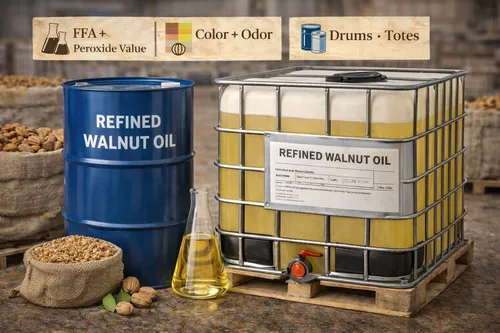
Bulk Refined Walnut Oil for wholesale supply — Atlas Nut Supply

Refined walnut oil program options

Common program variables (availability varies by supplier program and season):

  • Oil type selection: refined vs cold-pressed edible vs crude (specify which you need).
  • Quality targets: acid value/FFA, peroxide value, moisture/volatiles, insoluble impurities, odor/color, and filtration/clarity requirements.
  • End-use alignment: sauces/dressings, bakery/confectionery fat systems, nutritional blends, or private-label culinary programs (program dependent).
  • Packaging: drums or IBC totes; pallet patterns and receiving constraints can be planned.
  • Documentation: COA and supporting compliance documents available per program.

Need other walnut oil formats? See cold-pressed edible walnut oil or crude walnut oil.

Industrial applications

Where refined walnut oil is typically specified for consistency and stability:

  • Sauces & dressings: cleaner profile; specify PV/odor targets for stable shelf-life.
  • Baking & confectionery: consistent performance in blends, fillings, and fat systems.
  • Nutritional systems: ingredient blends where oxidation control is part of QA planning.
  • Private-label culinary oils: program dependent; specify pack/label needs early.

For formulation and storage guidance, see the Atlas Nut Academy.

Product specifications (quote-ready)

Below is a practical, buyer-friendly specification format used across comparable refined walnut oil programs. Actual delivered values are confirmed on the lot COA. If you have your own spec, send it—we’ll align to it.

INCI: Juglans Regia Seed Oil
CAS: 8024-09-7 / 84012-43-1
Appearance: pale yellow to golden yellow; neutral odor/taste (program dependent)

Oil quality is typically managed with measurable indicators (acid value/FFA, PV) plus “cleanliness” factors (moisture/volatiles, insoluble impurities, soap) and sensory expectations (odor/taste).

Parameter Typical program target Notes for buyers
Acid value (mg KOH/g) ≤ 0.6 Often used as the core indicator for FFA control; aligns to refined-oil trade expectations.
Peroxide value (meq O₂/kg) ≤ 5.0 (tighter target)
Codex refined oils: up to 10
Lower PV supports longer shelf-life and less oxidation risk in sensitive applications.
Matter volatile (at 105°C) ≤ 0.2% m/m A practical indicator for moisture/volatiles control in refined oils.
Insoluble impurities ≤ 0.05% m/m Helps protect filtration burden and reduces sediment risk.
Soap content ≤ 0.005% m/m Common refined-oil cleanliness metric (program dependent).
Refractive index (20°C) 1.474 – 1.478 Used for identity/consistency checks.
Relative density (20°C) 0.920 – 0.926 Useful for receiving QA and process calculations.
Odor / taste Neutral; free from foreign or rancid notes Sensory acceptance is commonly part of release criteria.

Fatty acid profile (typical)

Many programs include a fatty acid profile to confirm identity and natural variability.

Fatty acid Typical range (% of total fatty acids) Notes
C16:0 Palmitic 6.0 – 8.0% Identity / natural variation
C16:1 Palmitoleic ≤ 0.5% Identity / natural variation
C18:0 Stearic 1.0 – 3.0% Identity / natural variation
C18:1 Oleic 14.0 – 21.0% Influences oxidative behavior and mouthfeel
C18:2 Linoleic 54.0 – 65.0% Primary PUFA driver; oxidation planning matters
C18:3 Linolenic 9.0 – 15.0% Oxidation-sensitive; protect from heat/light/oxygen

If you need a specific spec language (AOCS / ISO / internal SOP references), include it in your request and we’ll match the supplier program accordingly.

Quality & handling checkpoints

Refined walnut oil is typically selected for a cleaner profile, but shelf-life still depends on oxidation control and good handling. These checkpoints are commonly used by QA and operations teams.

Use sealed containers; minimize headspace exposure; protect from heat and light. Many programs store in well-filled containers or under inert gas.

Confirm COA, lot traceability, odor/taste acceptance, and key indicators (acid value/FFA, PV). Define hold/retest rules for longer storage.

If your process requires clarity or low sediment, specify filtration requirements up front (and include temperature conditions if relevant).

Walnut is a major allergen. Share your facility and labeling requirements so the right documentation and handling lane is aligned.

Common documentation packages include COA, allergen statement, and traceability/country-of-origin support (availability varies by supplier program).

Packaging (drums & totes)

Packaging is usually selected based on consumption rate, pump/dispense setup, and storage conditions. Typical options include:

  • Drums: food-grade drums suitable for controlled lot usage and smaller consumption rates.
  • IBC totes: common for higher-volume lines to reduce changeovers and receiving events.
  • Headspace management: programs may support well-filled containers and/or inert gas handling where required.
  • Pallet patterns: align to your warehouse constraints and unloading method (dock/forklift).

If you have pump viscosity constraints, share your ambient temperature range and dispense setup so packaging and handling can be aligned.

Domestic & export logistics

Logistics planning for edible oils often depends on destination, temperature exposure risk, and documentation. To move faster, include:

  • Destination: city/state/country and preferred ship window (and port if export).
  • Incoterms / routing: if you have a preferred routing strategy or forwarder.
  • Documentation needs: COA, COO/traceability, allergen, and any channel-specific documents.
  • Temperature risk: note any constraints on heat exposure or seasonal routing.

For long export lanes, specifying a tighter PV target and strong oxidation controls can reduce risk at destination.

Similar products buyers compare

If you’re evaluating options, these are the most common “apples-to-apples” comparisons in market:

  • Cold-pressed edible walnut oil: stronger flavor profile; often specified differently than refined programs.
  • Crude walnut oil: intermediate input used for further processing/refining lanes.
  • Other refined specialty oils: buyers often apply similar QA frameworks (acid value/FFA + PV + moisture/volatiles + insolubles + sensory).

Related pages: Cold-Pressed Walnut OilCrude Walnut OilBulk Walnut Products

Specs checklist (fast quote)

Send your spec sheet if you have one. Otherwise, start here for faster alignment.

  • Product: Refined walnut oil
  • Quality targets: acid value/FFA, peroxide value, moisture/volatiles, insoluble impurities, and any odor/color limits
  • Filtration / clarity requirements: if applicable to your use
  • Oxidation/rancidity expectations: shelf-life goal and storage/distribution conditions
  • Allergen handling expectations: as applicable to your program
  • Packaging: drums or totes; pallet constraints and receiving method
  • Volume: first order + forecast cadence
  • Destination: city/state/country (and port if export)
  • Delivery window: required ship/receipt dates
  • Documentation: COA, traceability/COO, certifications if required

Share your end application (dressings, blends, baking systems, private-label) and we’ll help confirm practical quality and packaging targets for performance and shelf-life.

FAQ: Refined walnut oil

What specs do you need to quote bulk refined walnut oil?

At minimum: packaging (drums/totes), volume, destination, and timeline. For faster alignment, include QA targets like acid value/FFA, peroxide value, moisture/volatiles, insoluble impurities, and any odor/color or filtration requirements.

What’s the difference between refined and cold-pressed walnut oil?

Cold-pressed programs often preserve more characteristic flavor/aroma and may be specified differently. Refined programs are typically chosen when a cleaner/neutral profile and repeatable QA targets are preferred. If you share your application, we’ll suggest which lane is more suitable.

Is “acid value” the same as “FFA”?

They’re closely related. Acid value is commonly reported as mg KOH/g oil and is used to quantify free fatty acids (FFA). Some specs ask for FFA% (often “as oleic acid”), while others specify acid value directly. If you provide either, we can align quoting to your requirement.

Do you ship refined walnut oil outside the United States?

Yes. We support export lanes depending on destination, volume, packaging, and required documentation. Share the country/port and timeline for planning.

Can you provide COA and traceability documentation?

Yes. COA and traceability documentation are available per supplier program. If you require certifications, allergen statements, or specific document formats, note them in your inquiry.

How should refined walnut oil be stored for best shelf-life?

Store sealed, cool, and protected from heat, oxygen, and light. Avoid temperature swings and keep containers closed between use. Many programs recommend well-closed, well-filled containers (or inert gas where required) to reduce oxidation risk. Share your storage conditions and expected hold time for more specific guidance.