Walnut Pieces for Dairy Fruit Prep and Toppings: Migration and Softening Control
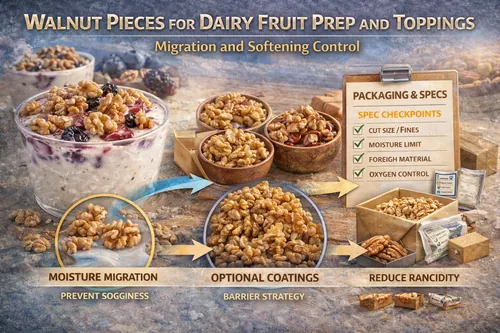
Industrial guide for walnut pieces used in dairy fruit prep and toppings: moisture migration, softening control, crunch retention strategies, spec checkpoints, and packaging/storage choices for bulk walnut programs.
Previous: Seasoned Walnut Snack Programs: Oil Management and Flavor Adhesion • Next: Walnuts in Plant-Based Foods: Texture, Flavor, and Allergen Labeling
Related: bulk walnut products • products catalog • request a quote
Where this format fits in production
Walnut pieces show up across dairy and dairy-adjacent systems where “real ingredient” texture matters: yogurt (stirred or fruit-on-bottom), dairy fruit preparations, cottage cheese / dessert cups, toppings for ice cream and frozen novelties, and crunchy inclusions for parfait/granola-style SKUs. The format choice is less about “what’s best walnut” and more about what survives the matrix (moisture, fat, sugar, freeze/thaw, shear) while still delivering the expected bite.
Primary failure mode in dairy: crunchy nuts are low water activity; dairy and fruit prep are high water activity. Moisture moves toward equilibrium, and the nut softens unless you add a barrier or change how/when it is combined.
Common “fit” examples:
- Dry topping / separate compartment: easiest crunch retention; standard pieces often work.
- Mixed into fruit prep: highest softening risk; consider barrier-coated pieces or system redesign.
- Stirred yogurt: moderate risk; pieces + process timing matter (add late, reduce dwell time before filling).
- Frozen desserts: texture is affected by freeze/thaw and syrup/fat migration; barriers can still help.
Migration and softening: what actually causes crunch loss
Crunch loss is usually a moisture/texture physics problem, not a “walnut quality” problem. In multi-component foods, components with different water activity exchange moisture until they approach equilibrium, which changes texture. With nuts, that typically means crisp → leathery/soft over time unless a barrier slows water pickup.
Fast diagnostics your team can run
- Soak test at use-conditions: hold walnut pieces in your fruit prep (target Brix/pH) and/or yogurt base at storage temp; measure texture at 1, 3, 7, 14 days.
- Water activity mapping: measure aw of the nut inclusion and the matrix; big gaps predict faster texture drift.
- Particle-size effect: smaller pieces soften faster (more surface area), while larger pieces retain bite longer.
Control levers that usually work
- Barrier coatings: fat-based or compound/chocolate-style coatings, sugar/glaze systems, or tailored edible films (most effective when the matrix is very wet).
- System design: keep nuts dry until consumption (dual-compartment lids; top-load after filling; include as a topping sachet).
- Process timing: add nuts as late as possible; minimize hot-hold or long residence times before packing.
- Matrix tuning: if feasible, reduce free water (solids, hydrocolloids) or limit direct contact with the wettest phase.
Format and spec checkpoints buyers should confirm
For dairy fruit prep and toppings, specs should connect to two outcomes: (1) texture retention in your matrix and (2) shelf-life stability (oxidation control). A clean spec sheet reduces surprises at scale-up.
Core inclusion specs
- Cut/size distribution: target mm range and maximum fines (fines disappear into the matrix and soften quickly).
- Moisture target: align to your crunch goal and receiving environment; avoid “wet” lots that start closer to softening.
- Roast profile (if used): light vs medium impacts flavor, color, and oxidation sensitivity.
- Defect & color limits: especially important for visible toppings and “clean” dairy presentations.
- Foreign material controls: metal detection expectations, screens, and documented controls.
If you need coated pieces (common in fruit prep)
- Coating type: fat-based/compound, sugar-based, or custom barrier (declare expectations clearly).
- Coating load: percent pick-up impacts crunch retention, cost, and label claims.
- Temperature stability: ensure coating won’t smear, bloom, or stick in your plant environment.
- Label alignment: confirm ingredients and “may contain” statements with QA/regulatory.
Buyer tip: if the walnuts will live inside a high-moisture phase for weeks, “standard walnut pieces” often fail the texture target—ask for a barrier approach or shift to a dry topping design.
Processing and shelf-life considerations
Walnuts are oxidation-sensitive. Heat exposure, oxygen, and time can drive flavor drift (rancidity notes) and shorten shelf life—especially if storage is warm or packaging has high oxygen transmission. Roasted formats can be more variable depending on process control and oil management.
Shelf-life risk reducers
- Oxygen control: low-OTR packaging, nitrogen flushing, and (program-dependent) oxygen absorbers.
- Temperature control: cooler storage is your friend; avoid long warm holds in warehouses or on docks.
- Light control: keep away from strong light where possible (especially for clear secondary packs).
- Inventory discipline: align PO timing and FEFO (first-expire/first-out) to your launch calendar.
Practical note: if your dairy SKU has a long refrigerated shelf life, the walnut inclusion must be stable for at least that long, plus transit and safety buffer. Make oxidation risk explicit in the spec and packaging request.
Packaging options for bulk programs
Packaging should protect against two enemies: moisture pickup (texture drift) and oxygen exposure (oxidation). Match packaging to your receiving environment and internal handling.
Common bulk options
- Lined cartons / bag-in-box: common for pieces; specify liner thickness and seal type.
- Sealed bulk bags: useful when humidity control is a concern; confirm pallet configuration.
- High-barrier film + nitrogen flush: when oxidation risk is high or shelf-life windows are long.
- Coated inclusions: often benefit from tighter seals and handling notes to reduce breakage and dusting.
Share your receiving constraints (dock conditions, storage temp, humidity exposure, repack needs, pallet height limits) early—most “delays” happen when packaging assumptions appear late in the process.
How to request a quote with fewer back-and-forths
For dairy fruit prep and toppings, include the matrix details that determine crunch retention. The more you share up front, the faster you get a realistic option set (standard pieces vs coated/barrier vs alternate format).
Send this checklist
- Application: stirred yogurt, fruit-on-bottom, fruit prep inclusion, dry topping, frozen dessert, etc.
- Target texture window: “crunch acceptable through day X” at your storage temperature.
- Matrix basics: moisture/aw targets if known; fruit prep Brix and pH; fat level; freeze/thaw exposure.
- Piece size: target mm range + max fines; inclusion rate (%) in finished product.
- Roast: raw or roast level preference; color expectations.
- Barrier need: uncoated vs coated; acceptable coating types/ingredients; target pick-up if coated.
- Quality/QA: defect limits, micro requirements, foreign material controls, documentation needed (COA, allergen, COO).
- Packaging: bag-in-box vs sealed film, nitrogen flush preference, case weight, pallet pattern.
- Volume + forecast: first order volume, annual run rate, launch timing, destination.
If you can share a quick bench result (even a 7-day texture check in your fruit prep/yogurt), it helps select the right barrier approach without weeks of trial-and-error.
Next step
If you share your application (stirred yogurt, fruit-on-bottom, fruit prep inclusion, or dry topping) and the crunch window you need, we can recommend a practical format (standard pieces vs barrier-coated vs alternate design), confirm spec targets, and align packaging. Use Request a Quote or email contact@atlastradehouse.com.