Seasoned Walnut Snack Programs: Oil Management and Flavor Adhesion
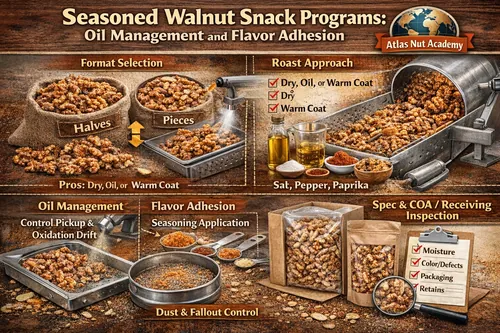
Industrial playbook for seasoned walnut snack programs: how to manage oil application and seasoning adhesion so finished packs look clean, taste consistent, and hold up over shelf life. Covers format selection (halves vs pieces), roast choices, seasoning systems and dust control, specs and COA fields, packaging options, and a receiving checklist for bulk walnut supply.
Previous: Managing Oxidation in Walnuts: Storage Temperature, Oxygen, and Light • Next: Walnut Pieces for Dairy Fruit Prep and Toppings: Migration and Softening Control
Related: bulk walnut products • products catalog • request a quote
Why seasoned walnut snacks are trickier than seasoned almonds (buyer perspective)
Seasoned walnuts can deliver a premium, distinctive flavor profile—but they can also drift faster than many nut snacks if the program is not built around oxidation control. Walnuts are relatively high in unsaturated fat, and seasoning systems often introduce additional variables: topical oil, salt and acids, spice particulates, sugar, and sometimes high-heat roasting steps.
From a procurement and QA standpoint, the program succeeds when you control two things at the same time: (1) adhesion and appearance (coverage, shine, low dust) and (2) shelf-life stability (low rancidity drift). Oil is the bridge between those goals—because it improves adhesion but can increase oxidation risk if not managed carefully.
Common “pain points” in seasoned walnut snack programs
- Seasoning fallout: dust in bags, inconsistent flavor, messy packing lines.
- Clumping: too much oil or insufficient cooling creates sticky clusters and uneven coverage.
- Greasy texture: excess surface oil reduces crunch and can cause consumer complaints.
- Uneven flavor intensity: poor mixing or particle segregation leads to “hot” and “bland” pieces.
- Rancidity drift: warm storage, oxygen exposure, older lots, or highly oxidizable oil choices accelerate complaints.
Buyer framing: A seasoned walnut program is not just a seasoning recipe—it’s a controlled system: walnut format + roast method + oil choice + seasoning physics + packaging + storage.
Format selection: halves vs pieces (and why size affects adhesion and shelf life)
Format choice influences everything: the premium look of the snack, seasoning coverage, fines generation, and oxidation sensitivity. Smaller pieces typically give more uniform seasoning distribution, but they also increase surface area, which can raise oxidation drift risk in warm lanes.
Walnut halves for seasoned snacks
- Pros: premium appearance; lower fines; better in “show” snacks and gift/tin programs.
- Operational benefits: less dust generation during conveying; easier visual QC in finished packs.
- Tradeoffs: higher cost; lower seasoning coverage per pound unless you tune oil and mixing carefully.
Walnut pieces for seasoned snacks
- Pros: more even seasoning distribution; good for bold flavors and value-priced snacks.
- Operational benefits: easier to dose in blends; less visible variation if color range is broader.
- Tradeoffs: more breakage/fines; higher surface area can mean faster oxidation drift if storage is warm or oxygen exposure is high.
How to choose quickly
- If the product is premium and visually driven, start with halves.
- If the product is flavor-driven and cost-sensitive, start with pieces (but control fines and packaging).
- If you ship through warm lanes or need a long shelf life, consider larger formats and stronger packaging posture.
Roast approach: dry roast vs oil roast vs “warm coat” (why it changes adhesion)
Seasoned walnuts may be produced using different thermal approaches depending on target flavor, crunch, and process constraints. Roast approach affects how well oil and seasoning bind to the surface—and how quickly the finished product drifts over time.
Dry roast / oven roast
Dry roasting develops flavor and reduces moisture, but adhesion depends heavily on the subsequent oil application step. Too hot a kernel can cause rapid oil absorption and patchy coverage; too cool a kernel may not bind seasoning well without longer mixing.
- Best for: clean flavor profiles; programs where you want to control oil separately from roast.
- Watchouts: kernel fragility can increase after roasting; handle gently to prevent breakage.
Oil roast (when used)
Oil roasting can create strong aroma and rapid heat transfer. It can also increase oil management complexity because you must manage oil quality over time and control how much surface oil remains after processing.
- Best for: bold flavor, strong roast notes.
- Watchouts: oil turnover and filtration are critical; excess surface oil increases greasiness and oxidation risk.
Warm coat / preheat to improve adhesion
Many plants use a “warm coat” approach: preheating walnuts to a controlled temperature and then applying a small amount of oil so seasoning binds quickly. The key is consistency—large temperature swings cause inconsistent oil pickup and can create clumps or dust.
Oil management: controlling pickup, surface oil, and oxidation drift
Oil plays three roles in seasoned walnut snacks: adhesion, mouthfeel, and appearance (shine). But oil also changes shelf-life risk, especially if oxygen exposure and storage temperature are not controlled. Good oil management is about applying the minimum effective oil to achieve adhesion and appearance targets while maintaining stability.
Key oil decisions in snack programs
- Oil type: chosen for flavor neutrality vs character, oxidative stability, and supply consistency.
- Application rate: enough to bind seasoning but not enough to feel greasy or create clumps.
- Application method: spray vs drizzle vs batch addition; impacts uniformity.
- Oil temperature and viscosity: affects how evenly it coats and how quickly it absorbs.
- Turnover and hygiene: especially important if oil is reused in a process line.
Common oil-related failure modes (and what they look like)
- Too little oil: dusty packs, seasoning settles at bottom, inconsistent flavor intensity.
- Too much oil: greasy feel, clumping, dark specks from seasoning agglomeration, faster rancidity drift.
- Poor distribution: “hot” pieces and “bland” pieces in the same bag.
- Insufficient cooling: oil remains mobile; seasoning slides off; packs look messy.
Operational tip: If you see dust, don’t automatically add more seasoning. First evaluate oil distribution and kernel temperature—many dust issues are adhesion issues, not seasoning rate issues.
Flavor adhesion: making seasoning stick without creating clumps
Seasoning adhesion is a physics problem: particle size, density, oil film thickness, and mixing energy determine whether seasoning sticks, falls off, or clumps. The goal is a thin, uniform oil film that captures seasoning particles and “sets” after cooling.
Variables that drive adhesion
- Seasoning particle size distribution: too fine increases dust; too coarse can bounce off and segregate.
- Seasoning density and shape: some blends adhere better due to particle morphology.
- Oil film thickness: too thin = fallout; too thick = clumping/greasy feel.
- Kernel temperature: warm kernels improve adhesion but must be controlled to prevent oil absorption spikes.
- Mixing time and energy: under-mixing causes uneven coverage; over-mixing can break kernels and create fines.
Adhesion strategies used in industrial snack lines
- Two-stage addition: apply oil first, then seasoning; optionally finish with a very light “lock-in” oil mist.
- Staged seasoning: add seasoning in portions to avoid instant overload and clumping.
- Controlled cooling: cool quickly enough to set the surface film and reduce migration.
- Anti-caking posture: choose seasonings that flow consistently in hoppers and resist bridging.
Dust and fallout control: keeping bags clean and flavor consistent
“Dust” is a finished-product problem and a plant housekeeping problem. It can cause messy packs, customer complaints, and inconsistent flavor. Dust usually comes from one of three sources: excess fines in the walnut input, seasoning that doesn’t adhere, or mechanical damage after coating.
How to reduce dust systematically
- Start with low-fines walnut lots: define a breakage posture for snack-grade halves/pieces.
- Match seasoning to the application: avoid overly fine blends if your line cannot bind them consistently.
- Control vibration and drops: excessive movement after coating creates fallout.
- Verify with a repeatable check: use a simple shake-and-sieve method to trend dust over time.
Buyer-friendly dust posture language
- “Low visible dust” in finished packs
- “No excessive loose seasoning” on opening
- Optional: define a maximum fines/loose seasoning level using an internal test method
A practical processing flow for seasoned walnut snacks (what QA can monitor)
Many seasoned walnut lines follow a similar flow, even if equipment differs. The QA advantage comes from defining checkpoints that predict finished-product outcomes: kernel temperature, oil rate, seasoning rate, mixing time, cooling profile, and packaging seal integrity.
Typical flow
- Incoming walnuts: verify format, color/defect posture, moisture, and odor.
- Preheat/roast: develop flavor and set kernel temperature for coating.
- Oil application: controlled spray/drizzle to establish a uniform film.
- Seasoning application: staged addition to avoid clumps and segregation.
- Tumbling/mixing: enough energy for coverage, not so much that kernels shatter.
- Cooling: set the coating and reduce oil mobility.
- Packaging: minimize oxygen exposure; maintain seal integrity; reduce headspace if possible.
What to trend if complaints show up later
- Oil rate and oil temperature
- Seasoning particle size / lot changes
- Kernel temperature at coating
- Cooling time and exit temperature
- Bag dust and headspace oxygen posture (if you measure it)
- Storage temperature and distribution lanes
Shelf-life and oxidation: the constraint that should shape your whole program
Walnuts are sensitive to oxidation, and seasoning systems can amplify this sensitivity by adding surface oil and increasing surface exposure. Your shelf-life outcome depends on three things: lot freshness, oxygen exposure, and temperature. If any of these are out of control, rancidity complaints become much more likely.
What increases rancidity drift risk
- Warm storage or hot transit lanes
- High headspace oxygen in packaging or frequent opening of bulk containers
- Older inventory used late in shelf-life windows
- High fines levels (more surface area) in pieces-heavy programs
Controls that buyers and QA teams can use
- Prefer low-defect, clean lots and define a sensory acceptance posture at receiving.
- Use packaging aligned to your shelf-life target and distribution lane temperature.
- Reduce oxygen exposure after opening bulk containers; reseal liners immediately.
- Align pack size with consumption rate so product doesn’t sit open in partial containers.
Packaging options that protect seasoned walnuts
Packaging matters more in seasoned walnut snacks than many buyers expect. Seasoned products are often more sensitive to oxygen exposure, and oil mobility can increase mess if packaging is compromised.
Bulk and production packaging options (program-dependent)
- Lined cartons/bags: common for kernels and pieces; confirm liner seal integrity.
- Barrier packaging: stronger oxygen and moisture posture for longer shelf-life targets.
- Pack size alignment: match to line consumption rate to reduce repeated opening.
- Lot code visibility: supports traceability and complaint isolation.
Packaging details buyers should specify
- Seal integrity expectations: no punctures, strong liner seals, correct closures.
- Pallet configuration: reduce crush and shifting; define wrap and stack if needed.
- Odor protection posture: avoid exposure to strong odors in storage and transit.
Specs checklist for seasoned walnut snack programs
Even if you season in-house, your raw walnut input spec is what protects your yield and shelf-life. Keep the spec focused on the few parameters that drive snack outcomes.
Minimum fields most buyers should define
- Format: halves or pieces; define target piece band if using pieces.
- Color expectation: tighter for premium snacks; broader for bold-flavor/value programs.
- Defect posture: insect damage, shrivel, and “no visible mold/decay” posture.
- Foreign material posture: shell fragment tolerance + escalation rule for hard FM/metal.
- Moisture: expectation and verification method (COA and/or receiving).
- Sensory acceptance language: clean, fresh walnut aroma; no rancid/painty/musty notes.
- Packaging: lined cartons/bags, seal integrity, lot code visibility.
Optional fields for sensitive or export programs
- Microbiology (program-dependent): align to your category requirements.
- Fines/breakage posture: define maximum fines if dust is a chronic issue.
- Storage/shipping expectations: temperature guidance for warm lanes when applicable.
COA checklist: fields that support acceptance and traceability
COA content varies by supplier and destination requirements. A practical COA supports receiving decisions and traceability.
Common COA fields buyers request
- Lot identification: must match packaging labels and shipping documents.
- Product description: walnut kernels; halves or pieces; raw/roasted if applicable.
- Moisture: value and (if provided) method reference.
- Allergen statement: tree nut (walnut) declaration aligned to labeling needs.
- Country of origin: for compliance and labeling workflows.
- Traceability identifiers: production/shipment identifiers for issue isolation.
- Defect summary (if provided): aligned to your defect and foreign material posture.
- Microbiology (program-dependent): aligned to your category requirements.
Receiving checklist (snack-program friendly)
- Packaging integrity: no punctures, water damage, broken seals; correct labeling and lot codes.
- COA match: lot ID matches case labels and documents.
- Odor check: clean, fresh walnut aroma; no rancid/painty/musty notes.
- Visual check: color distribution aligned to spec; minimal shell fragments; no visible mold/decay.
- Moisture verification: confirm against target (especially during humid or warm seasons).
- Retains: keep a retained sample by lot for complaint investigation and shelf-life tracking.
Snack QA tip: Add a simple “warm sniff” check (gentle warming of a small sample) for early rancidity notes in sensitive programs. Use consistent internal procedure and training to keep it repeatable.
Questions to ask suppliers (snack-procurement focused)
- What are typical defect and color ranges for this grade and crop year? Helps set realistic limits.
- What foreign material controls are used? Screening, aspiration, optical sorting, metal controls (program-dependent).
- How is the product stored and shipped? Temperature posture and transit lane guidance.
- What packaging formats are available? Select packaging aligned to your shelf-life and lane risk.
- What documentation is available? COA, allergen, COO, traceability, and compliance docs as needed.
Tightening raw walnut specs can improve snack outcomes, but the biggest wins often come from storage temperature, oxygen exposure control, and packaging discipline. Build those controls into the program early rather than trying to “fix” shelf-life later.
FAQ: oil management and seasoning adhesion in walnuts
Why does seasoning fall to the bottom of the bag?
Typically because the oil film is too thin or uneven, the seasoning is too fine or poorly matched to the line, or the product experiences heavy vibration after coating. Improve oil distribution, adjust seasoning particle size, and reduce post-coating handling stress.
Why do seasoned walnuts sometimes clump?
Clumping often comes from excess oil, insufficient cooling, or seasoning overload applied too quickly. Staged seasoning addition and controlled cooling usually reduce clumping without sacrificing flavor intensity.
How do I reduce rancidity complaints?
Start with clean, low-defect lots and protect them: cool storage, minimize oxygen exposure, avoid heat in transit, and align packaging size to consumption rate so product does not sit open in partial containers.
Should I tighten color specs for seasoned snacks?
Only if appearance is an acceptance driver. In bold-flavor or heavily seasoned programs, a broader color range can be acceptable without changing consumer outcomes—especially when walnuts are coated and visual differences are less noticeable.
Next step
If you share your target snack profile (sweet, savory, spicy), format (halves or pieces), destination, and shelf-life target, we can recommend practical raw walnut checkpoints (color/defects/foreign material/moisture) plus packaging options aligned to your program. Use Request a Quote or email info@almondsandwalnuts.com.
For sourcing, visit bulk walnut products or browse the full products catalog.