
Risk Management for Nut Buyers: Currency, Freight, and Crop-Year Strategy
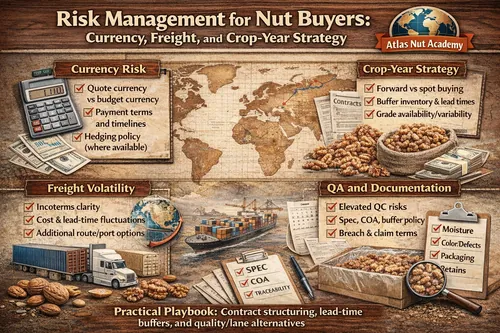
Global market guide for procurement teams: manage currency exposure, freight volatility, and crop-year timing in bulk almond and walnut programs. Includes contract structures, lead-time buffers, and practical checklists to reduce supply and quality surprises.
Previous: How Buyers Track Almond and Walnut Prices: Reports, Contracts, and Timing
Related: bulk almond and walnut products • products catalog • request a quote
Why risk management matters in nut procurement
Almond and walnut markets can look calm—right up until they aren’t. Even when “market price” is stable, buyers still face volatility in currency, freight/lead times, and crop-year availability. The best procurement teams treat risk as something to engineer: contract structure, buffers, documentation discipline, and alternative supply lanes.
Core idea: Don’t try to predict every market move. Build a program that performs even when assumptions break: currency swings, freight delays, or crop-quality variability.
Table of contents
- 1) The risk map: what can go wrong
- 2) Currency risk: practical controls
- 3) Freight & lead-time risk: planning and contract levers
- 4) Crop-year strategy: timing, coverage, and quality variability
- 5) Spot vs forward: building a blended coverage plan
- 6) Quality & shelf-life risk: moisture, oxidation, and storage
- 7) A simple risk-management playbook (templates & checklists)
- Next step
1) The risk map: what can go wrong
Most surprises fall into five buckets. Knowing which bucket you’re in helps you choose the correct tool.
- Price risk: market moves, form-specific tightness (blanched/cut lanes), and basis changes.
- Currency risk: quote currency vs budget currency, payment timing, and FX volatility.
- Freight risk: rate changes, routing constraints, port delays, and container availability (export/import lanes).
- Supply/availability risk: crop size/quality variability, carry-in inventory, competing demand lanes.
- Quality risk: moisture variance, oxidation/rancidity, foreign material control, micro requirements, and shelf-life performance.
Shortcut: If your disruption would stop production, you need supply continuity controls (coverage, alternates, buffers). If it would blow up margins, you need commercial controls (currency/freight/contract structure).
2) Currency risk: practical controls
Define your exposure clearly
The hidden trap isn’t “FX exists”—it’s misalignment between the currency of your quote, the currency of your budget, and the currency of your payment. Risk increases when the time between PO and payment is long.
Common control options (choose what matches your organization)
- Quote currency policy: Standardize the quote currency for each region/program so Finance can forecast.
- Shorter pricing validity windows: Align offer validity with volatility (especially for spot buying).
- Forward cover / hedging policy: If your company hedges FX, align PO timing and payment schedules to the hedge window.
- Split risk explicitly: Define whether currency moves after booking are buyer risk or seller risk (and how adjustments work).
Operational best practice
Build a simple internal worksheet per SKU: (1) quote currency, (2) expected payment date, (3) exposure window, (4) who owns FX risk, and (5) approval thresholds when the rate moves.
3) Freight & lead-time risk: planning and contract levers
Freight volatility is a service-level risk, not only a cost risk
Late product can be more expensive than higher freight. Nuts are shelf-life sensitive, and long dwell times can also increase quality risk if temperature and handling are not controlled.
What buyers can control
- Incoterms clarity: Confirm who owns booking, insurance, and risk transfer points.
- Mode strategy: Match mode to shelf-life and service level (ocean vs air vs domestic trucking, where relevant).
- Routing redundancy: Identify at least one alternate route/port or carrier option for critical lanes.
- Lead-time buffers: Plan with conservative transit + clearance time for export programs.
- Receiving constraints upfront: Pallet configuration, appointment scheduling, and warehouse capacity affect speed and cost.
Freight rule of thumb: The more time-sensitive your production schedule, the more valuable a “boring” logistics plan becomes: predictable lanes, earlier booking, and approved alternates.
4) Crop-year strategy: timing, coverage, and quality variability
Crop-year planning reduces two risks at once
Crop-year timing affects availability (what’s in the pipeline) and quality variability (moisture, defects, and shelf-life performance).
Three crop-year concepts buyers use
- Base load vs variable load: Identify the volume that is “always there” and the volume that flexes with sales.
- Coverage windows: Define how many months ahead you must be covered to protect production.
- Lane qualification: Approve alternates (grade, size range, or packaging) so you can pivot when a form tightens.
For processed forms, crop-year strategy includes conversion capacity
If you buy blanched, sliced, diced, meal/flour, butter, or oil, your risk isn’t only “almond supply.” It’s also the capacity and lead time of the conversion lane. During peak demand, conversion lead times can be the bottleneck.
5) Spot vs forward: building a blended coverage plan
Spot buying (flexibility)
- Pros: adapt to demand changes; less forecasting pressure.
- Cons: more exposure to short-term tightness, freight shocks, and sudden market moves.
Forward coverage (stability)
- Pros: reduces supply uncertainty; improves production planning; can stabilize margin.
- Cons: needs forecasting discipline; can create overbuy risk if demand falls.
A practical blended approach
Many teams forward-cover the base load for core SKUs and leave the variable portion for spot buying. This protects production while preserving flexibility.
Decision cue: If a SKU is hard to substitute and costly to stop (line shutdown), forward-cover more. If it’s easy to substitute or reduce (promo/seasonal), keep more flexibility.
6) Quality & shelf-life risk: moisture, oxidation, and storage
Even with stable pricing and on-time delivery, quality drift can quietly destroy program economics: higher defects at receiving, shorter shelf life, and increased waste.
What drives quality risk most often
- Moisture variability (storage safety and shelf-life performance)
- Oxidation exposure (heat, light, oxygen; roasted formats are especially sensitive)
- Foreign material controls (plant performance and receiving inspection results)
- Micro requirements aligned to category risk
What buyers do about it
- Use a spec that matches the finished-product risk posture, not just “standard commodity.”
- Align packaging to transit and storage conditions.
- Define receiving acceptance criteria (and what triggers a hold/retest).
- Keep documentation consistent: COA, allergen statement, country of origin, and any program-specific compliance docs.
7) A simple risk-management playbook (templates & checklists)
One-page “SKU risk card” (recommended)
- SKU / form: (kernels, blanched, slices, meal, butter, oil, in-shell)
- Criticality: A = line-stopper, B = manageable, C = flexible
- Coverage target: X weeks/months ahead
- Approved alternates: spec ranges, packaging alternates, secondary lane
- Commercial terms: currency, incoterm, payment timing, price validity
- Quality controls: moisture target, defect limits, micro requirements, shelf-life expectations
- Escalation triggers: FX move threshold, freight spike threshold, lead-time threshold, defect spike threshold
Program-level “risk buffer” checklist
- Inventory buffer: define minimum safety stock for A SKUs
- Dual sourcing: qualify at least two supply lanes when possible
- Logistics redundancy: alternate routes/carriers/ports (as applicable)
- Documentation readiness: have COA/micro/allergen/origin requirements standardized
- Review cadence: monthly for stable programs; more frequent during volatile periods
Related reading: How Buyers Track Almond and Walnut Prices: Reports, Contracts, and Timing • Global Almond Consumption Trends: Key Regions and Product Forms • Global Walnut Consumption Trends: Snack, Bakery, and Culinary Demand
Next step
If you share your application and the format you need, we can confirm common spec targets, packaging options, and the fastest supply lane. Use Request a Quote or email info@almondsandwalnuts.com.