
Global Almond Consumption Trends: Key Regions and Product Forms
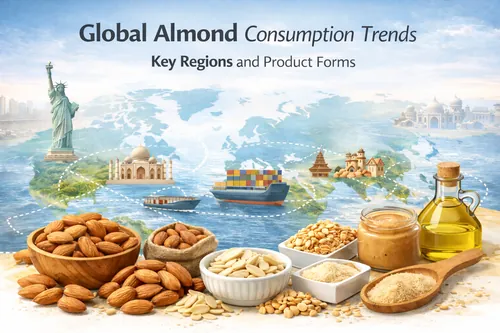
Global market guide: how almond demand varies by region and product form (in-shell, kernels, blanched, slices/dice, meal/flour, butters, oils). Covers consumption drivers, trade lanes, seasonality, and procurement checkpoints for bulk almond programs.
Previous: Traceability and Crop-Year Planning for Walnut Buyers: Forecasting and Programs • Next: Global Walnut Consumption Trends: Snack, Bakery, and Culinary Demand
Related: bulk almond and walnut products • products catalog • request a quote
Why “consumption trends” matter to industrial buyers
Almond demand is global, but it is not uniform. Some markets pull primarily kernels for snacking and ingredient use. Others have meaningful demand for in-shell for retail display and seasonal gifting. Meanwhile, food manufacturing increasingly pulls processed forms—blanched, sliced, diced, meal/flour, and butters—because they reduce in-plant labor and improve line consistency.
For procurement teams, the practical question is: Which demand lane is competing for the same product form you need? When you understand that, you can choose better specs, lock supply at the right time, and avoid surprises (availability, lead time, or sudden basis changes for a specific form).
Fast takeaways:
• Kernels drive the broadest, most stable demand (snack + ingredient manufacturing).
• Blanched and cut forms are “processing lanes” where conversion capacity and yield matter—availability can tighten even when kernel supply is steady.
• In-shell demand is often seasonal and culturally driven; it can change short-term availability in certain export windows.
• The “right” almond is the one that meets your spec with minimal rework and predictable shelf-life performance.
Table of contents
- 1) What drives almond demand globally
- 2) Key consuming regions and what they buy
- 3) Product forms: how demand splits by format
- 4) Seasonality and promotional timing
- 5) Trade lanes: what buyers monitor
- 6) Procurement implications: specs, risk, and planning
- 7) Quote-ready checklist for bulk almond sourcing
- 8) FAQ
1) What drives almond demand globally
Snacking is the backbone
In many markets, almonds are a default “better snack” choice—easy to portion, easy to pack, and compatible with a wide range of flavors. This supports steady baseline demand for whole kernels and a growing set of value-added snack programs (roasted, seasoned, coated).
Bakery and confectionery create consistent ingredient pull
Almonds are deeply embedded in bakery and confectionery usage: inclusions, toppings, fillings, pastes, and premium textures. These categories often prefer cut forms (sliced, slivered, diced) and blanched kernels because appearance and process performance matter.
Plant-based and “better-for-you” formulations expand form demand
Growth in plant-based and high-protein positioning (bars, beverages, spreads) tends to pull almond meal/flour, almond butter/paste, and other processed ingredients. This demand can be less seasonal and more tied to product launches and manufacturing run rates.
Convenience is the invisible driver in B2B
Industrial buyers frequently switch forms not because consumers asked, but because plants need better throughput and less variability. Pre-processed forms reduce steps: blanching, slicing, dicing, or milling inside your facility.
Buying insight: Demand shifts often show up first as a change in form mix (more blanched/cut/milled), not as a dramatic change in total almond tonnage.
2) Key consuming regions and what they buy
“Regions” are not single markets—but procurement planning gets easier when you recognize common patterns: what forms dominate, what seasonality matters, and what quality cues buyers prioritize.
North America: diversified demand across snacks and ingredient manufacturing
- Strong kernel demand for retail snacking and private-label programs
- Stable industrial pull for bakery, cereals, bars, and inclusions
- Growing processed forms for convenience: blanched, sliced, diced, meal/flour, butter
Procurement tends to be documentation-heavy for national programs and large manufacturers, with clear COA and receiving requirements.
Europe: mature usage with strong bakery, confectionery, and ingredient channels
- High usage of cut forms (sliced/slivered/diced) for bakery and confectionery
- Consistent retail demand for kernels and ingredient packs
- Specs and compliance (documentation and consistency) are often decisive in supplier qualification
India: culturally embedded usage with seasonal surges and gifting
- Strong consumer recognition of almonds in sweets, snacks, and home use
- Seasonality can be influenced by holiday calendars and gifting cycles
- Form preference often leans toward kernels (whole) and value-added packs, with rising processed forms for modern food manufacturing
East & Southeast Asia: growing modern snack demand plus ingredient adoption
- Rising snack and convenience formats (portion packs, flavored almonds)
- Ingredient demand growth for bakery and café-style products
- Premium cues (appearance, uniformity) can matter for retail-facing programs
Middle East & North Africa: culinary usage + gifting and retail display
- Culinary integration in sweets and savory dishes supports steady demand
- Seasonal buying can cluster around holidays and celebrations
- Mixed form demand (kernels plus selected processed forms for manufacturing)
Practical regional takeaway: If your program relies on a specific form (e.g., blanched slices), watch the regions that pull that same form most aggressively—those are your “competition lanes.”
3) Product forms: how demand splits by format
Almonds are one commodity with many “mini-markets.” Each form has its own demand drivers, processing constraints, and price behavior. Below is a buyer-oriented map of the most common forms.
Whole kernels (natural)
The workhorse form for global consumption: snacking, inclusions, roasting, and ingredient blending. This lane is often the most liquid and the easiest to source at scale—but specs still matter (size/grade, defects, moisture).
In-shell almonds (natural)
In-shell programs are typically driven by retail display, gifting, and regional tradition. Demand can be seasonal and market-specific. Buyers still confirm crack-out expectations, internal quality, and shell appearance.
Blanched almonds
Blanched almonds support premium appearance and certain processing requirements. They are common in confectionery, bakery, and some culinary applications. This is a conversion lane—availability depends on processing capacity and yield.
Sliced, slivered, diced (cut forms)
Cut forms are pulled heavily by bakery and toppings. They are more sensitive to: particle distribution, breakage, flowability, and foreign material controls. Small changes in distribution can create big changes in line performance and finished appearance.
Meal / flour
Meal/flour is used for coatings, texture systems, bakery bases, and certain plant-based formulations. Buyers typically confirm mesh/particle distribution, fat content expectations (program dependent), and packaging that protects freshness.
Almond butter / paste
Almond butter/paste demand is driven by bars, fillings, spreads, sauces, and plant-based formulations. Programs often require clear sensory expectations (roast notes, sweetness/neutrality), packaging compatibility, and shelf-life alignment.
Almond oil (program dependent)
Almond oil is a smaller lane compared with kernels and cut forms, but it matters for certain premium culinary and ingredient systems. Buyers typically confirm packaging, sensory expectations, and any filtration/refining notes.
Form-selection shortcut: Start from the production step you want to eliminate. If you don’t want to blanch, buy blanched. If you don’t want to mill, buy meal/flour. If you need visual impact, buy the cut that shows best.
4) Seasonality and promotional timing
Almond supply is seasonal, but demand is year-round. Many buyers manage this mismatch by planning around: (1) promotional calendars, (2) product launch timing, and (3) the lead time required to convert almonds into the forms they need.
Common seasonal demand patterns
- Holiday baking windows drive cut forms (slices/dice) and confectionery usage
- Gifting cycles can increase retail pull for premium kernels and in-shell (market dependent)
- Snack promotions can create sudden pull for roasted/seasoned kernels and portion packs
What to do as a procurement team
- Map each SKU’s peak months (and your manufacturing build schedule).
- Work backward from ship windows to procurement dates, especially for converted forms.
- Set a shelf-life buffer that matches your storage conditions and distribution time.
5) Trade lanes: what buyers monitor
Buyers typically track “signals” that affect availability and delivered cost. The exact mix depends on the program, but common inputs include:
- Crop size and quality expectations (how much is available and what grades/forms will be tight)
- Carry-in inventory and supplier coverage
- Conversion lane tightness (blanching/cutting capacity; lead times)
- Freight and transit constraints (lead times, temperature exposure risk, and port congestion variability)
- Currency effects (especially for export programs)
- Destination market demand spikes (promotions and holiday timing)
Monitoring tip: If you buy a converted form (blanched/cut/milled), track both the underlying kernel market and the conversion lane capacity—those can move independently.
6) Procurement implications: specs, risk, and planning
Specs are a production tool, not paperwork
A strong spec reduces rework and stabilizes throughput. Typical checkpoints include moisture, size/cut distribution, defect limits, roast profile (if applicable), foreign material controls, and microbiological requirements based on category.
Match packaging to shelf-life and logistics
Packaging choice should reflect your storage time, transit exposure, and the sensitivity of your finished product. The correct packaging is the one that protects quality without creating receiving headaches (pallet pattern, bag sizes, re-pack constraints).
Qualify at least two supply lanes when possible
For high-volume programs, risk management often means having more than one qualified lane: a primary spec that runs best, and an approved alternative spec (or origin/program lane) that can cover disruptions.
Use crop-year and demand timing to reduce surprises
Align buying timing with production calendars. If you’re launching a new SKU, validate documentation and samples early, then lock coverage based on your risk posture (spot vs forward coverage).
7) Quote-ready checklist for bulk almond sourcing
The fastest way to get an accurate offer is to send a complete request. Even a short email can prevent multiple rounds of clarification.
Include these fields
- Product form: kernels (whole), in-shell, blanched, sliced/slivered/diced, meal/flour, butter/paste, oil
- Grade/size: target and acceptable range
- Moisture target (and any special storage constraints)
- Defect limits and foreign material expectations
- Micro requirements (category-specific)
- Roast profile (if buying roasted or if you need “roast-ready” behavior)
- Packaging: bag size, liners, cartons, pallets; receiving constraints
- Volume: first order + annual forecast
- Destination and required ship window
- Timeline and any launch deadlines
If you share your application and the format you need, we can confirm common spec targets, packaging options, and the fastest supply lane. Use Request a Quote or email info@almondsandwalnuts.com.
Related reading: How to Request a Quote for Bulk Almond Products: The Spec Sheet Buyers Use • How Buyers Track Almond and Walnut Prices: Reports, Contracts, and Timing
8) FAQ
Which almond form is “best” for industrial buying?
It depends on your process. Whole kernels are the most flexible. Blanched and cut forms improve visual consistency and reduce in-plant steps. Meal/flour and butter/paste support texture and plant-based formulations. The best form is the one that hits spec with the fewest internal processing steps.
Why do blanched and sliced markets sometimes feel “tighter” than kernels?
Because they depend on conversion capacity and yields. Even if kernel availability is stable, lead times for blanching/cutting can tighten during peak bakery seasons.
Do in-shell almonds matter to kernel buyers?
Yes—when in-shell demand spikes in certain destinations, it can affect sorting flows and availability for particular grades. If you buy kernels, you still watch in-shell demand as a competing pull.
What should be on a COA or receiving checklist?
Programs vary, but buyers commonly validate moisture, defects, foreign material controls, and microbiological parameters relevant to their category, plus allergen and origin documentation as needed.
Next step
If you share your application and the format you need, we can confirm common spec targets, packaging options, and the fastest supply lane. Use Request a Quote or email info@almondsandwalnuts.com.