In-Shell Walnuts (Natural vs Bleached): Market Preferences and Handling Notes
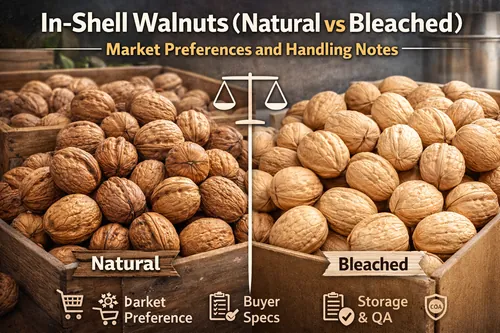
Industrial guide for in-shell walnuts (natural vs bleached): buyers often choose between “natural shell” and “bleached shell” primarily for appearance and market preference, not because the kernel is a different product. This article explains what each term typically means, where market preferences come from, and how to manage quality risk through specs, packaging, storage, and documentation—especially for export programs and retail-forward destinations.
Previous: Walnuts for Ice Cream and Frozen Desserts: Texture and Freeze/Thaw Considerations • Next: Export Programs for Walnuts: Moisture, Sorting, and Documentation Basics
Related: bulk walnut products • products catalog • request a quote
Buyer takeaway: In-shell walnut decisions are usually about presentation (shell color uniformity) and market fit. The biggest functional risks are still the classic ones: moisture management, shell integrity, foreign material controls, and temperature/oxygen exposure that can impact kernel freshness.
Table of contents
- What “in-shell walnuts” means for industrial and export programs
- Natural vs bleached: what changes (and what does not)
- Why markets prefer one shell appearance over another
- Quality risks that matter more than shell color
- Handling and storage notes for in-shell walnuts
- Packaging options for bulk in-shell programs
- Buyer specs checklist: what to confirm before you buy
- Documentation and compliance notes (practical)
- Where in-shell fits: retail, gifting, cracking operations, foodservice
- Troubleshooting common complaints
- FAQ
- Next step
What “in-shell walnuts” means for industrial and export programs
“In-shell walnuts” are walnuts sold with the shell intact. This form is common for retail holiday programs, gifting, traditional cracking at home, certain foodservice presentations, and some export markets where in-shell is culturally preferred. For industrial buyers, in-shell can also be a way to supply cracking operations that produce kernels locally, or to target markets that value the natural “whole nut” presentation.
Compared with shelled kernels, in-shell walnuts often have a different risk profile:
- Shell integrity becomes a spec driver (cracks, splits, staining, insect damage, empties).
- Size/count grading matters for presentation and packing.
- Kernel freshness still matters—the shell is not a complete barrier against oxidation over time.
- Handling is different: weight, bulk density, and packaging methods are not the same as kernels.
If you’re buying in-shell walnuts for a cracking operation, your priorities may shift toward crack-out yield and internal kernel condition. If you’re buying for retail/export presentation, your priorities may shift toward shell appearance, uniformity, and packaging aesthetics.
Natural vs bleached: what changes (and what does not)
Natural in-shell walnuts
“Natural” typically means the shell color is not intentionally lightened for presentation. Natural shells can range from light tan to darker brown and may show more visual variation due to orchard conditions, harvest timing, and handling. For many markets, natural appearance is acceptable—or even preferred—because it signals a more “natural” product and aligns with rustic or traditional expectations.
Bleached in-shell walnuts
“Bleached” in-shell walnuts have undergone a shell appearance treatment designed to lighten and even out shell color. The goal is usually presentation: a brighter, more uniform shell that looks “clean” and premium in certain retail displays or destination markets.
What does NOT change: the core kernel freshness drivers
The biggest misconception is that shell color treatment changes the kernel into a different functional product. The core freshness and shelf-life drivers are still: time, temperature, oxygen exposure, and moisture management. In-shell is generally more protective than shelled kernels, but it is not immune to cumulative storage and heat exposure.
Practical buying note: If your primary goal is kernel eating quality, prioritize crop-year freshness, storage discipline, and supplier program controls. Choose natural vs bleached mainly based on your market’s presentation preference.
Why markets prefer one shell appearance over another
Market preference is shaped by consumer expectation, retail norms, and cultural cues. Some destinations and retail programs associate lighter, more uniform shells with cleanliness and premium presentation. Other markets value natural variation or prefer a “no treatment” narrative.
Where bleached shells can be favored
- Retail presentation programs: where visual uniformity and bright appearance improve shelf appeal.
- Gift and holiday assortments: where the product is judged quickly on appearance.
- Some export destinations: where consumer expectation is strongly tied to light shell color.
Where natural shells can be favored
- “Natural/less processed” positioning: markets that prefer minimal processing narratives.
- Traditional cracking markets: where consumers focus more on kernel taste than shell uniformity.
- Value-oriented channels: where cost efficiency matters more than presentation.
For procurement teams, the decision is often commercial: does the premium for appearance generate sales or margin downstream? If not, natural may be the more efficient supply lane.
Quality risks that matter more than shell color
Shell appearance can influence acceptance, but the biggest program risks are usually operational and quality-control related. These are the issues that can trigger receiving holds, claims, or downstream performance problems.
1) Moisture and storage stability
In-shell walnuts still require moisture management to prevent quality loss. Excess moisture can increase the risk of off-odors or storage instability. Too-dry product can increase brittleness and shell breakage during handling.
2) Shell integrity and defect tolerance
Cracks, splits, and shell damage can be a major buyer concern, especially for retail presentation and for reducing contamination risk. Define acceptable tolerances and align inspection methods early.
3) Foreign material control
In-shell products can carry more field-related debris risk than kernels if controls are weak. A strong program will have cleaning and screening controls appropriate for the destination and packaging format.
4) Internal kernel condition (hidden quality)
The shell can mask internal kernel issues until cracking. If you are buying for cracking operations, consider sampling approaches that evaluate internal condition, crack-out yield, and kernel appearance or odor.
Handling and storage notes for in-shell walnuts
Handling discipline often determines whether in-shell walnuts arrive as a premium product or an inconsistent one. Even though the shell provides protection, walnuts still respond to heat, oxygen exposure over time, and poor staging conditions.
Storage best practices
- Keep temperature controlled: cooler storage supports freshness and reduces oxidation risk in the kernel over time.
- Avoid prolonged dock staging: heat spikes during loading/unloading can accelerate aging.
- Control humidity: avoid conditions that allow moisture uptake or condensation.
- Protect from strong odors: nuts can absorb odors during storage and transit.
- Use FIFO rotation: in-shell is not “set and forget”—inventory turns still matter.
Handling best practices
- Minimize drops and rough handling: reduces shell cracking and breakage.
- Confirm pallet stability: shell product can be heavy; stable pallets reduce damage and claims.
- Prevent contamination: keep product covered during staging and maintain clean storage zones.
Packaging options for bulk in-shell programs
Bulk in-shell programs commonly use bags or cartons depending on the channel and destination. Packaging choice affects handling damage, presentation, and moisture/oxygen exposure.
Common packaging formats
- Bulk bags: efficient for industrial and cracking operations; confirm bag strength and pallet configuration.
- Cartons with liners: can improve handling protection and presentation for certain programs.
- Retail-ready packs: destination and program dependent; often needs additional labeling and presentation requirements.
Packaging decisions buyers should align early
- Pallet pattern and height: affects container utilization and damage risk.
- Liner needs: depends on humidity and storage plan.
- Re-pack constraints: if the destination requires smaller packs, plan lead times and handling steps early.
For export programs, packaging is part of risk management: stronger packaging can reduce damage claims and preserve appearance through long transit.
Buyer specs checklist: what to confirm before you buy
The fastest path to an accurate offer is a clear spec. For in-shell walnuts, include both appearance requirements and functional requirements. Use the checklist below as a starting point.
Core commercial items
- Natural vs bleached: specify which you need for your market/program.
- Variety/type: confirm the type appropriate for your destination expectations.
- Crop year / pack window: align freshness needs and shipping schedule.
- Destination and lane: affects packaging and documentation needs.
Quality and grading items (typical)
- Size/count range: key for retail presentation and packing consistency.
- Moisture target: align to storage plan and destination climate.
- Shell integrity: tolerance for cracks, splits, chips, and broken shells.
- Shell appearance: acceptable color range, staining tolerance, and uniformity expectations.
- Foreign material: expectations and controls.
- Insect damage/defects: tolerance appropriate to your program.
Operational items
- Packaging: bag/carton type, liners, net weights, pallet configuration.
- Labeling: destination compliance, language needs, lot coding requirements.
- Inspection method: agree on how lots are evaluated to avoid disputes.
If you’re supplying a cracking operation: consider adding crack-out yield expectations and internal kernel condition checks to the spec conversation.
Documentation and compliance notes (practical)
Documentation needs vary by destination and channel. Many buyers request a baseline package plus destination-specific items. Typical documentation may include COA, country of origin, allergen statements, and supporting compliance documents (program dependent).
For export programs, plan ahead for any additional documentation, inspection requirements, or labeling rules that might affect lead times. If shell appearance treatment matters for your destination, confirm any required declarations or documentation expectations early.
Related reading: Export programs for walnuts.
Where in-shell fits: retail, gifting, cracking operations, and foodservice
In-shell walnuts are most commonly used where the shell itself adds value: presentation, tradition, and perceived freshness. Common use cases include:
- Retail holiday and seasonal programs: appearance is a key sales driver.
- Gifting and premium assortments: shell uniformity often matters.
- Cracking operations: focus shifts to yield and internal quality.
- Foodservice presentation: niche uses where whole-nut presentation is part of the experience.
Align your program to the use case. If consumers crack at home, shell integrity and presentation dominate. If you crack industrially, internal kernel outcomes dominate.
Troubleshooting common complaints
Complaint: “Shells are too dark / not uniform”
This is usually a spec alignment issue. Confirm whether the program requires bleached shells or a narrower natural-color band. Agree on acceptable ranges and inspection methods.
Complaint: “Too many cracked shells”
Check handling and packaging first: rough transit, poor pallet stability, or excessive drops can increase damage. Also review shell integrity tolerances and how they were measured.
Complaint: “Kernel flavor is stale after cracking”
Investigate storage temperature and time in transit. Even in-shell walnuts can age if exposed to heat for long periods. Improve temperature discipline, reduce dwell time, and align inventory turns to consumption pace.
Complaint: “Foreign material / dirty appearance”
Confirm cleaning/screening controls and packaging protection. In-shell products often require robust cleaning steps appropriate to destination expectations.
FAQ
Is bleached always “better” for export?
Not always. Some destinations prefer bleached shells for presentation; others prefer natural shells or do not pay a premium for appearance. The right choice depends on your destination market and channel.
Do in-shell walnuts have longer shelf life than kernels?
Often, yes—because the shell provides a degree of protection. But shelf life still depends heavily on temperature and time. Heat exposure can shorten shelf life even for in-shell product.
What’s the most important spec item for in-shell programs?
For retail and gifting, it’s usually size and shell appearance plus integrity. For cracking operations, it’s usually yield and internal kernel condition plus moisture and storage discipline.
Next step
If you share your application and the format you need, we can confirm common spec targets, packaging options, and the fastest supply lane. Use Request a Quote or email info@almondsandwalnuts.com.
To get the fastest quote, include: in-shell walnut type (natural or bleached), target size/count range, packaging (bags/cartons), destination, volume, and timeline—plus any required documentation or labeling requirements for your market.
Quick links: bulk walnut products • products catalog • contact