
Bulk supply • Drums/totes • Quote-ready specs • California sourcing

Bulk Crude Walnut Oil

Atlas Nut Supply, LLC supplies bulk crude walnut oil for manufacturers, blenders, and ingredient buyers that need a predictable procurement lane—not a one-off spot buy. We cooperate with multiple California processors and bulk programs to match your quality specification, packaging, documentation, and delivery requirements for domestic U.S. routes and export.

Crude oil programs are typically qualified around oxidation stability and downstream process fit. If you’re blending, refining, deodorizing, or running an industrial formula, share your FFA/acid value, peroxide value (PV), color/odor expectations, and receiving constraints—then we’ll align the right program.

Product
Crude walnut oil
Bulk packs
Drums • IBC totes
Support
COA • traceability • export docs
FFA / Acid value max Peroxide value (PV) max Moisture/impurities Color & sensory Packaging & lane

Request a quote Specs checklist Spec table Back to catalog

Fastest quoting: share FFA/acid value max, PV max, target odor/color, packaging (drum/tote), volume, destination (and port if export), and required docs (COA/traceability/COO/certs).

Looking for other walnut formats? See bulk walnut products (kernels, pieces, meal, and more).
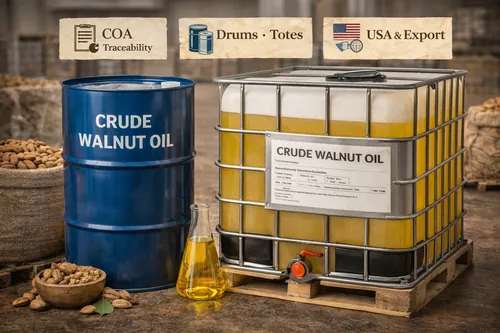
Bulk Crude Walnut Oil for wholesale supply — Atlas Nut Supply

Bulk supply focus: what industrial buyers actually need

Procurement teams typically qualify oil programs around repeatability, risk controls, and handling reality. We build quotes around those realities:

  • Program alignment: steady lane vs. spot volume, forecast planning, and lead-time expectations
  • Quality targets: FFA/acid value, PV, moisture/impurities, and agreed sensory/color profile
  • Packaging & handling: drum or IBC tote programs matched to receiving constraints
  • Documentation: COA, traceability/lot docs, allergen/COO statements, export paperwork (as required)
  • Delivery lanes: U.S. domestic shipment planning and export routes depending on destination and documentation

Have a spec sheet? Send it with your inquiry for the fastest match. If not, use the checklist in Specs.

Crude vs. refined: pick the right lane

“Crude” and “refined” are not interchangeable procurement lanes. Crude walnut oil is typically selected when:

  • You plan to refine/deodorize (in-house or via a third party)
  • You’re blending into an ingredient system where final sensory is managed downstream
  • You need a bulk input aligned to defined oxidation limits rather than retail-finished polish
  • Your priority is documentation + repeatability for manufacturing, not consumer-facing presentation

If you need a refined or culinary finished program instead, note it in your request—we can align alternatives depending on availability and targets.

Crude walnut oil options

Common program formats (availability varies by supplier program and season):

  • Crude walnut oil (bulk): quote built around FFA/PV/moisture/impurities, sensory, packaging, and lane
  • Cold-pressed edible lanes: program-dependent options for culinary ingredient use
  • Refined alternatives: for buyers requiring lower odor/color targets
  • Documentation support: COA/traceability, allergen statements, country of origin, export docs upon request

Tell us your receiving constraints (forklift access, dock height, temperature controls) and we’ll match a compliant pack-out.

Industrial applications

Typical manufacturing and ingredient uses:

  • Sauces & dressings: emulsions, flavor systems, specialty formulations
  • Baking & confectionery: fat systems, flavor-forward blends
  • Nutritional blends: documented inputs and consistent lots for QA programs
  • Processing input: base oil for refining/deodorizing or blending (program dependent)

For broader ingredient and procurement guidance, see the Atlas Nut Academy.

Product specifications (program-defined, quote-ready)

Use this table to set expectations and speed up approvals. For crude oils, final targets are quote-defined to match your process, but most buyers align to the same core parameters: FFA/acid value, PV, moisture/impurities, and sensory/color.

Parameter What to specify Why it matters Notes
FFA / Acid value Max target (your spec) Primary indicator of hydrolytic degradation and crude processing conditions Commonly used as a go/no-go spec for crude oil qualification.
Peroxide value (PV) Max target (your spec) Oxidation marker that correlates to shelf-life risk and off-notes If you need longer stability, specify handling/storage constraints too.
Moisture / Volatile matter Max target (your spec) Impacts stability, microbial risk in residues, and processing performance If you filter or refine, define upstream vs. post-processing targets.
Insoluble impurities Max target (your spec) Impacts clarity, filtration, and downstream refining throughput Define whether you require pre-filtered/crude-with-settling.
Color & appearance Target range + clarity expectation Controls batch-to-batch consistency in blends and finished products Crude oils vary more—confirm if you need “low color” crude.
Odor / sensory profile Neutral vs. characteristic notes Key for dressings, flavor systems, and low-heat applications If you deodorize downstream, you can widen this tolerance.
Identity checks Density / refractive index (if required) Common QA identity screens for incoming edible oils We can align COA fields based on your internal QA template.
Fatty acid profile Report required? (Yes/No) Supports nutrition labeling, blend behavior, and formulation consistency Walnut oil is typically high in polyunsaturated fats; oxidation control matters.
Packaging Drum or IBC tote + receiving constraints Prevents unloading surprises and delays Specify dock height, forklift access, max pallet weight/height.
Documentation COA / traceability / COO / certifications Needed for audits, export clearance, and lot control List required documents in the RFQ for fastest alignment.

If you’re unsure which targets to set, share your end use (refining, blending, sauces/dressings, bakery, etc.) and your shelf-life expectation. We’ll recommend practical target bands to reduce production risk.

Walnut oil composition (reference ranges)

Many buyers request fatty-acid reporting for formulation and QA. Typical walnut oil ranges are dominated by linoleic acid (omega-6), with meaningful linolenic (omega-3) and oleic fractions. Use these as reference ranges for finished oil identity screens.

  • Oleic (C18:1): 14–21% (typical reference range)
  • Linoleic (C18:2): 54–65% (typical reference range)
  • Linolenic (C18:3): 9–15% (typical reference range)

If you need a full fatty-acid panel on the COA, request it in the RFQ.

Quality benchmarks for finished edible oils (helpful for targets)

Some teams use industry benchmarks as guardrails when setting targets. Finished edible oil programs often reference limits for peroxide value and acid value/FFA (limits vary by oil type and processing lane).

  • Peroxide value (PV): commonly specified as a max meq O2/kg target
  • Acid value / FFA: commonly specified as a max target for acceptance
  • Moisture/volatile & insoluble impurities: typically defined as max % targets

Crude oil programs may have wider tolerances than refined/final edible lanes. The right target is the one that fits your downstream process and shelf-life risk.

Packaging: drums & IBC totes

Bulk walnut oil is typically packed for industrial receiving. Specify your constraints up front to prevent unloading delays.

  • Drums: common bulk program pack (palletized as applicable)
  • IBC totes: common for higher throughput receiving and fewer handling touches
  • Larger bulk options: program-dependent (for high-volume buyers)
  • Labeling: lot ID, production date, and document linkage for traceability

Tell us: dock constraints, forklift/clamp preferences, max pallet height/weight, and whether you need temperature-controlled receiving.

Storage & handling (oxidation control)

Walnut oil is relatively high in polyunsaturated fats, so oxidation control matters. Best practices depend on your spec and packaging, but most programs benefit from:

  • Protecting from heat, light, and air exposure
  • Maintaining sealed containers; minimizing headspace exposure during transfers
  • Using FIFO rotation and documenting lot traceability in your internal workflow
  • Confirming whether nitrogen blanketing is needed for sensitive applications

Share your storage temperature range and intended use, and we’ll recommend program-appropriate handling to support stability.

Documentation & compliance support

Typical documentation available upon request (varies by supplier program):

  • COA (including key quality parameters you specify)
  • Traceability / lot documentation
  • Allergen statements and handling declarations
  • Country of origin documents
  • Export documentation support depending on destination requirements

If you need certifications or special compliance documents, list them in your inquiry so we can match the right supplier program.

Specs checklist (quote-ready)

Send your spec sheet if you have one. Otherwise, use this checklist to reduce back-and-forth and speed up approvals.

  • Product: crude walnut oil (note if you need refined or cold-pressed alternative)
  • Quality targets: FFA/acid value max, peroxide value (PV) max, moisture/impurities max, color range, sensory/odor expectations
  • Intended use: refining/deodorizing, blending, ingredient system, sauces/dressings, bakery/confectionery, etc.
  • Micro requirements: if applicable to your internal QA program
  • Allergen handling expectations: specify any required declarations or facility constraints
  • Packaging: drums or IBC totes; include receiving constraints and pallet limits
  • Volume: first order quantity + rolling forecast (monthly/quarterly)
  • Delivery cadence: one-time shipment vs scheduled releases
  • Destination: city/state/country (or port), incoterms preference (if export), and required delivery window
  • Documentation: COA fields required, traceability, COO, and any certifications if required

Share your end application and processing details and we’ll help confirm crude walnut oil targets for performance, stability, and procurement consistency.

Request a quote Contact options

FAQ: Crude walnut oil

What is crude walnut oil used for in manufacturing?

Crude walnut oil is used as a bulk input for refining/deodorizing, for blending into ingredient oil systems, and in sauces/dressings or specialty formulations where the finished sensory profile is managed downstream. The best lane depends on your targets for FFA/PV/color/sensory and documentation requirements.

What specs do you need to quote bulk crude walnut oil?

To quote quickly: packaging (drums/totes), volume and destination, and your quality targets (FFA/acid value max, peroxide value max, moisture/impurities max, and color/sensory expectations). If you need certifications or special compliance docs, include them in the inquiry.

Do you supply crude walnut oil in drums or totes?

Yes. Bulk programs commonly ship in drums or IBC totes (availability varies by supplier). Share receiving constraints, pallet preferences, and delivery lane so we can align a compliant pack-out.

Do you ship crude walnut oil outside the United States?

Yes. We support domestic U.S. delivery and export lanes depending on destination, volume, and documentation requirements. Share the country/port and timeline so we can plan routing and paperwork.

Can you provide COA and traceability documentation?

Yes. COA and traceability documentation are available per supplier program. If you require additional compliance documents or certifications, note them in your request so we can match the correct program.

How should crude walnut oil be stored for best shelf-life?

Best practices depend on your quality targets, packaging, and facility conditions. In general, reduce exposure to heat, light, and oxygen, keep containers sealed, use FIFO rotation, and maintain lot-level traceability. Share your storage conditions and intended use and we’ll recommend program-appropriate guidance.

Crude vs refined walnut oil: what’s the practical difference?

“Crude” typically indicates an upstream processing lane intended for further processing or blending, while “refined” is typically selected to reduce color/odor and tighten quality parameters for finished applications. If your process includes deodorizing/refining, a crude program may be the correct lane; if your product is sensory-forward and not further processed, a refined or culinary finished lane may be a better fit.