
Walnuts in Sauces (Pesto-Style, Romesco-Style): Emulsions and Heat Stability
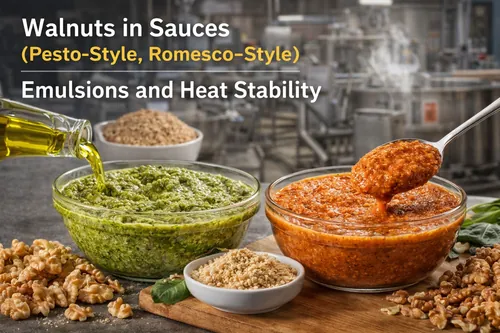
Industrial guide for walnuts in sauces (pesto-style, romesco-style): how walnut format and particle size influence emulsion stability, oil separation control, and heat stability. Includes a practical buyer spec checklist, process notes, packaging options, and documentation expectations for bulk walnut programs.
Previous: Walnuts for Granola and Cereal: Crunch Retention and Packaging to Prevent Rancidity • Next: Walnuts for Ice Cream and Frozen Desserts: Texture and Freeze/Thaw Considerations
Related: bulk walnut products • products catalog • request a quote
Where this format fits in production
Walnut-based sauces show up across refrigerated deli items, shelf-stable sauces, foodservice tubs, and components used in meal kits and prepared foods. In practice, “pesto-style” and “romesco-style” span a wide range: from coarse, rustic textures to smooth, pumpable emulsions.
- Pesto-style: often targets bright flavor + smooth-to-medium texture; separation is visible and heavily penalized.
- Romesco-style: often has higher solids (e.g., peppers, tomato, crumbs) and can tolerate more texture—yet still benefits from stable fat binding.
Walnut format selection: what drives emulsion and heat stability
Pieces (halves/pieces)
Best when you want a rustic texture and will grind in-house. The risk is particle size variability: larger particles can release oil unevenly and reduce stability if viscosity is low.
Meal / fine granulation
Often a sweet spot for industrial sauce lines: more consistent dispersion, faster hydration, and improved emulsion robustness versus coarse grinds—especially if your process has limited shear.
Paste / butter (ground walnut base)
Useful when you need high consistency and reduced in-plant grinding variability. Can simplify processing and improve batch-to-batch performance, but you’ll want to validate oxidation posture and any separation tendency over your hold time.
Rule of thumb: as particle size gets finer and more consistent, sauces tend to resist oil separation better, especially under moderate heat or hold times.
Process notes that impact separation (especially during heating)
- Grind order matters: build a stable “base” (walnuts + part of the liquid/oil phase) before adding remaining oil aggressively.
- Temperature control: excessive heat during grinding can thin viscosity and accelerate oxidation, increasing separation risk.
- Shear balance: too little shear leaves coarse particles that weep oil; too much shear can over-thin and destabilize depending on formulation.
- Hold time: long hot holds can increase oil rise—plan for mixing and packaging flow that minimizes hot residence time.
Spec checkpoints buyers should confirm (sauce-specific)
Sauce applications tend to be unforgiving on flavor drift and visible separation, so buyers typically tighten a few controls:
Quality & performance
- Moisture target: supports stability and reduces mold/storage risk upstream.
- Defect/color limits: important for appearance in green/herb sauces and lighter emulsions.
- Particle size distribution (for meal/paste): one of the biggest drivers of emulsion stability and mouthfeel.
Food safety & documentation
- Micro requirements: align to your category (refrigerated vs shelf-stable, lethality step or not).
- Allergen controls: clear statements and segregation practices where required.
- COA + traceability: ensure lot linkage for audits and complaint response speed.
Oxidation posture
- Storage conditions pre-ship: cool, controlled storage helps protect flavor before it becomes a sauce ingredient.
- Pack style: oxygen barrier choices (liners, sealed bags) matter more for milled forms and longer lead times.
Packaging options for bulk sauce programs
Bulk programs commonly use lined bags/cartons for pieces and meal, and drums/totes for paste or oil-based walnut ingredients. For sauce manufacturers, the key is matching packaging to oxygen exposure risk and line handling.
- Pieces / meal: lined cartons or bags; consider higher-barrier liners for longer storage windows.
- Paste / butter: pails, drums, or totes; confirm headspace management and resealability if you partial-use.
How to request a quote with fewer back-and-forths
Send: walnut format (pieces/meal/paste), target texture/PSD, raw vs roasted preference, moisture target, micro requirements, packaging, first order volume, annual forecast, destination, and timeline. If you have a sauce spec sheet (including your heat step and hold time), include it—this shortens qualification.
Next step
If you share your sauce style (pesto vs romesco), desired texture (smooth vs rustic), process (cold blend vs heated), packaging preference, and destination, we can confirm common spec targets and the fastest supply lane. Use Request a Quote or email info@almondsandwalnuts.com.