
Pasteurized Walnut Kernels: Micro Targets, Shelf Life, and When to Specify
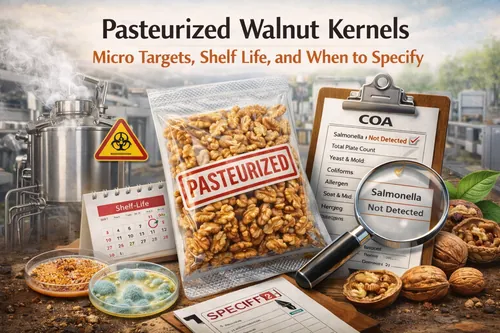
Industrial guide to pasteurized walnut kernels: microbial targets, shelf life drivers, and when to specify pasteurized vs standard kernels. Includes procurement-facing checklists for specs, COA expectations, validation language, packaging options, storage notes, and supplier questions for bulk walnut programs.
Previous: Walnut Halves and Pieces: Grade Selection for Industrial Buyers • Next: Dry Roasted vs Oil Roasted Walnuts: Flavor Development and Oxidation Risk
Related: bulk walnut products • products catalog • request a quote
What “pasteurized walnut kernels” means for industrial buyers
In bulk walnut procurement, pasteurized kernels generally refers to walnut kernels that have received a validated lethality treatment intended to reduce pathogen risk in a low-moisture food. The most important point for buyers is simple: pasteurization is not just a marketing label—it should map to a documented process and a controlled post-treatment handling program.
Because walnuts are a low-moisture product, microbes typically do not grow during storage the way they might in high-moisture foods. However, contamination can still occur and can persist in low-moisture environments. Many buyers specify pasteurized kernels when their product is ready-to-eat (RTE), minimally processed, or when a customer or destination requires an upstream kill-step.
Procurement reality: pasteurization is only one part of risk control. The overall system includes validated treatment, prevention of recontamination, foreign material controls, traceability, and storage practices that protect flavor and shelf life.
When to specify pasteurized walnut kernels (and when standard kernels are usually fine)
The fastest way to decide is to start with your finished product process and your customer requirements. Ask: “Does our process include a validated kill step after walnuts are added?” and “Are we selling into an RTE or high-sensitivity channel?”
Common situations where buyers specify pasteurized kernels
- RTE inclusions and toppings: snack mixes, salad toppers, granola mixes, or any product where walnuts are eaten without further cooking.
- Minimal processing after receiving: simple blending, portioning, or packing without a validated lethality step.
- Customer or destination requirements: some brands, retailers, or export lanes require upstream pasteurization or specific micro testing.
- Long shelf-life targets: not because pasteurization automatically extends sensory shelf life, but because buyers often pair it with tighter controls overall.
- Risk posture alignment: when your internal food safety program requires validated upstream lethality for low-moisture ingredients.
Common situations where standard kernels may be acceptable
- Fully cooked or baked applications: if your process provides a validated kill step after walnuts are added (program dependent).
- Heavy-flavor or short-turn products: where sensory drift is less visible and inventory turns quickly (still requires good quality and FM controls).
- Internal lethality treatment: some buyers treat kernels downstream and use upstream specs focused on defects, moisture, and FM controls.
Decision note: “pasteurized” is not automatically “better” for every application. It can affect cost, availability, and lead time. The right choice is the one that meets your risk and customer requirements with stable supply.
Micro targets and COA expectations for pasteurized walnut kernels
Micro specifications for walnuts vary by buyer risk posture, customer requirements, intended use, and destination. The most useful approach is to separate pathogen requirements (often “not detected” in the specified sample size) from indicator organism targets (which help track sanitation and process control).
How buyers typically structure microbiological requirements
- Pathogen target (program-dependent): commonly framed as absence of Salmonella in the required sample size, when required by program/spec.
- Indicator organisms: total plate count (TPC/APC), yeast & mold, and coliforms are commonly requested depending on your category and customer needs.
- Process hygiene indicators: some programs include additional indicators based on internal standards or customer audits.
- Testing cadence: per lot, per production day, or per defined sampling plan—this matters as much as the numerical target.
Procurement note: targets must match sampling plan and lab method
A “tight” micro number with an unclear sampling plan often creates disputes at receiving. Align your spec with: (1) the sample size, (2) the lab method reference, and (3) how nonconforming results are handled (hold/retest/disposition). This keeps purchasing, QA, and the supplier aligned.
COA line items buyers commonly request (micro + quality)
- Micro: Salmonella (if required), TPC/APC, yeast & mold, coliforms (program dependent).
- Moisture: a key stability driver for walnuts (shelf-life and mold risk posture).
- Defects: insect damage, mold/decay, foreign material categories (as specified).
- Sensory statement (if available): clean odor/flavor expectations at shipment.
- Traceability: lot codes, production identifiers.
- Allergen statement: walnut (tree nut) declaration.
- Country of origin: used in labeling and compliance workflows.
Best practice: If micro specs are critical to your release process, request a sample COA format before you place the first order. This avoids surprises about what the supplier can (and cannot) report on each lot.
Validation language: what to look for when a supplier says “pasteurized”
In industrial programs, the most helpful confirmation is not a vague statement like “treated”—it’s validation language that connects the process to an intended outcome and a control program. Buyers often ask for a summary statement that the process is validated to achieve a defined lethality objective (exact statements vary by supplier program and customer requirements).
Procurement-friendly checklist for pasteurization documentation
- Process identification: what type of pasteurization is used (supplier may describe it as steam, heat, or other validated low-moisture treatment).
- Validation status: confirmation the process is validated under the supplier’s food safety plan (details may be proprietary).
- Lot traceability: ability to tie treated lots to production identifiers.
- Post-treatment handling controls: measures that reduce recontamination risk (segregation, sanitation, controlled environments, packaging controls).
- Release criteria: whether release is based on COA, hold-and-release testing, or program-defined verification steps.
Important: buyers should avoid over-specifying proprietary process details. Focus on outcomes and controls: validated lethality, traceability, verification, and post-treatment contamination prevention.
Recontamination risk: why pasteurized kernels still need strict handling
Pasteurization reduces risk at a point in time. But walnuts can be re-exposed after treatment through equipment surfaces, handling steps, packaging, or the environment. This is why mature supplier programs treat pasteurization as one layer in a broader system: sanitation, segregation, packaging discipline, and traceability.
Where recontamination typically happens in supply chains
- Post-treatment transfer: conveyors, bins, or bulk handling steps after the kill step.
- Rework loops: mixing treated and untreated material is a common audit focus; buyers should ask how rework is controlled.
- Packaging line exposure: time and handling after treatment can increase exposure if controls are not tight.
- Warehouse practices: open pallets, damaged liners, or poor segregation can increase risk.
Buyer takeaway: when pasteurization matters, specify not only micro outcomes but also the documentation and lot controls that show the program prevents recontamination.
Shelf life: what actually drives stability in walnut kernels
For walnuts, shelf life is usually limited by oxidation (rancidity) and sensory drift rather than microbial growth. Pasteurization may support food safety objectives, but sensory shelf life depends heavily on: oxygen exposure, temperature, time, moisture history, and kernel integrity.
Primary drivers of rancidity risk in industrial programs
- Temperature: warmer storage accelerates oxidation. Temperature swings can also create condensation risk in some shipping scenarios.
- Oxygen exposure: risk increases after opening; partial containers and resealing discipline matter.
- Time in inventory: long holds require tighter specs and tighter storage practices.
- Kernel damage: broken pieces and damaged kernels typically oxidize faster than intact kernels.
- Light exposure: especially relevant for repacked or display packaging downstream.
What “shelf life” should mean in your spec
Many programs list a shelf-life duration, but buyers get better outcomes when they define shelf life in operational terms: acceptable odor/flavor at receipt, acceptable sensory at end of finished-product life, and storage conditions required to achieve it. If your finished product is flavor-delicate, add a clear sensory acceptance clause and keep retains.
Practical note: if you grind walnuts (butter, paste, meal), oxidation can accelerate because surface area increases. In those programs, packaging and cold storage become even more important.
Packaging and storage options for pasteurized walnut kernels
Packaging choices influence both food safety posture (preventing contamination after treatment) and shelf-life performance (reducing oxygen exposure and moisture ingress). The right packaging depends on consumption rate, handling practices, and transit lane.
Common packaging formats in bulk walnut programs
- Lined cartons/bags: common for kernels, halves, and pieces; specify liner type and sealing expectations if critical.
- Barrier packaging (program dependent): options that reduce oxygen exposure for longer holds or long transit lanes.
- Bulk totes/supersacks (where applicable): used in some industrial lanes; confirm liner integrity and receiving constraints.
Storage guidance buyers often include in specs
- Cool, dry storage: a foundational control to protect sensory shelf life.
- FIFO and lot discipline: avoid long open-container time after breaking seals.
- Odor segregation: store away from strong odors (walnuts can pick up environmental odors over time).
- Handling after opening: reseal quickly; use smaller pack sizes if your line consumes slowly.
Packaging choice rule: match packaging to consumption rate. If a container sits open for days, quality risk increases quickly—even with great upstream product.
Spec checklist: pasteurized walnut kernels (procurement-ready)
A strong spec buys you predictability. For pasteurized kernels, include four layers: (1) format and grade, (2) defects and moisture, (3) microbiological requirements (if applicable), and (4) documentation/traceability.
1) Format and grade
- Format: kernels, halves, pieces (define the target cut/size if relevant).
- Grade/color target: define what “acceptable appearance” means for your application.
- Intended use: RTE inclusion vs cooked/baked use (helps the supplier align micro/testing options).
2) Moisture, defects, and foreign material
- Moisture target: set to protect shelf life and reduce mold risk posture.
- Defect limits: insect damage, mold/decay, shrivel, dark/blemished kernels (as relevant).
- Foreign material limits: shell fragments and other FM categories aligned with your receiving plan.
- Sensory acceptance: clean odor/flavor; no musty, stale, or rancid notes at receipt.
3) Micro requirements (program dependent)
- Pathogen requirement: define “not detected” expectations and the sample size where required by your program.
- Indicator targets: define which indicators matter to you and the test plan expectations.
- Release model: COA-based, hold-and-release, or other program-defined verification step.
4) Documentation
- COA: specify required line items (moisture, micro where applicable, defects if provided).
- Allergen statement: walnut declaration.
- Country of origin: labeling/compliance workflows.
- Traceability: lot codes and identifiers tied to production.
- Supporting compliance docs (if required): request availability early (varies by supplier program).
If you want a “fast quote” process, send this checklist with your inquiry. It reduces back-and-forth and prevents mismatched offers.
Receiving and sampling: how to protect your program after the truck arrives
Even the best upstream program can fail if receiving is inconsistent. Create a simple receiving routine that ties directly to your spec. This produces usable supplier performance data and reduces subjective decisions lot to lot.
Receiving inspection checklist (buyer-friendly)
- Packaging integrity: no punctures, water damage, broken seals; correct labeling and lot codes.
- Odor check: clean walnut aroma; no painty, rancid, musty, or stale notes.
- Visual check: color consistency; minimal shell fragments; no visible mold clusters.
- COA verification: confirm required line items and that lot codes match paperwork.
- Retains: keep retained samples by lot for shelf-life tracking and complaint investigation.
Sampling and hold decisions (practical)
If pasteurization and micro targets are central to your release decision, define a clear internal workflow: what triggers a hold, who approves release, and what evidence is required (supplier COA, internal testing, or both). The goal is consistency, not complexity.
Operational tip: Keep a “reference lot” sample that represents acceptable aroma and appearance for your SKU. Comparing against a reference reduces debates when a lot is borderline.
Supplier questions that reduce risk (and speed up qualification)
These questions are designed for procurement and QA teams who need clear answers that map to controls and documentation. Use them during supplier qualification and again when buying new crop-year lots.
Pasteurization and verification
- What does “pasteurized” mean in your program? Ask for process identification and validation status (high level).
- How do you prevent recontamination after treatment? Segregation, sanitation, controlled handling, packaging discipline.
- What is your release model? COA-based, hold-and-release, or program-defined verification.
Micro and documentation
- Which micro tests can you report per lot? Confirm COA line items and sample size expectations.
- What is your nonconformance policy? Holds, retesting, disposition pathways.
- What supporting docs are available? allergen statement, COO, traceability, and compliance docs required by your customers.
Shelf-life and storage
- What storage conditions do you recommend? Connect to your shelf-life target and distribution lane.
- What packaging options reduce oxygen exposure? Especially for long holds or slow-consumption plants.
- Do you have sensory acceptance guidance? Helps standardize receiving decisions.
If your program is export-driven or high-sensitivity, request documentation availability before the first PO. Many delays happen because compliance expectations are clarified too late.
FAQ: pasteurized walnut kernels
What does “pasteurized walnut kernels” mean in industrial procurement?
It typically means the kernels were treated with a validated lethality step intended to reduce pathogen risk. Buyers should confirm validation language and the controls that prevent recontamination after treatment.
Do pasteurized walnuts always have different taste or color?
Not always. Many programs aim to minimize sensory impact, but results depend on process type and control. If your SKU is sensitive, specify sensory acceptance and request a sample or reference standard.
What microbiological targets are commonly requested?
Many buyers request pathogen “not detected” outcomes where required, plus indicators like total plate count and yeast/mold. Targets and sampling plans vary widely by customer, destination, and application—align requirements to your internal risk assessment.
When should I specify pasteurized kernels instead of standard kernels?
Pasteurized kernels are commonly specified for RTE or minimally processed applications, customer/destination requirements, and programs without a downstream validated kill step. If your process provides a validated kill step after walnut addition, standard kernels may be acceptable depending on your program requirements.
Does pasteurization extend shelf life for walnuts?
Shelf life is usually driven by oxidation, oxygen exposure, packaging integrity, and storage temperature. Pasteurization supports microbial risk objectives, but cool storage and protective packaging are the biggest drivers of sensory shelf-life performance.
Next step
If you share your application and the format you need, we can confirm common spec targets, packaging options, and the fastest supply lane. Use Request a Quote or email info@almondsandwalnuts.com.
For sourcing, visit bulk walnut products or browse the full products catalog.