Dry Roasted vs Oil Roasted Walnuts: Flavor Development and Oxidation Risk
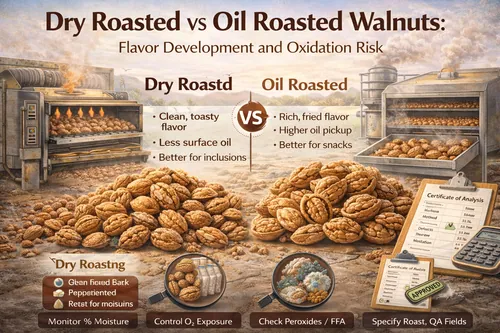
Dry roasting and oil roasting can both deliver strong walnut flavor—but they create different sensory outcomes and different oxidation risks. The right choice depends on your application (snacks, bakery, confectionery, sauces), your desired flavor curve, and how you manage shelf-life. This guide outlines practical differences, key QA checkpoints, and how to specify roasted walnuts with fewer surprises.
Previous: Pasteurized Walnut Kernels: Micro Targets, Shelf Life, and When to Specify • Next: Diced Walnuts for Bars and Snacks: Cut Size, Dust, and Line Performance
Related: bulk walnut products • products catalog • request a quote
Where each roast method fits
Start with the use case, then choose the roast approach that hits flavor and line performance targets with the fewest compensating steps.
- Dry roasted walnuts: best when you want a “clean” roasted nut note, lower surface oil, and easier inclusion handling (less greasy dusting, better flow in some hoppers).
- Oil roasted walnuts: best when you want rounder, richer flavor, strong aroma release, and a “fried/roasted” profile that holds up in snack seasoning systems.
Buyer shortcut: if your system is seasoning-heavy (snacks), oil roast can amplify aroma and adhesion; if your system is inclusion-driven (bakery/confectionery), dry roast often reduces handling mess and oil migration.
Flavor development: what changes in the cup
Both methods use heat to drive Maillard and caramel-like notes, but the “path” differs:
- Dry roast tends to produce sharper toast notes and a more defined “nutty” top note, with less added richness.
- Oil roast tends to produce a fuller, rounder profile with stronger aroma bloom; the frying medium can soften harsh notes and increase perceived richness.
If your product uses delicate dairy, chocolate, or mild bases, the cleaner dry roast profile can integrate more predictably. If your product needs boldness (savory snacks, spiced inclusions), oil roast can push flavor forward.
Oxidation risk: why roast method matters
Walnuts are naturally prone to oxidation because of their fatty acid profile, and roasting can accelerate oxidation if oxygen, heat, or light exposure isn’t controlled. The roast method changes the risk picture:
- Dry roast risk: the nut’s own oils are exposed and heated; if post-roast cooling and packaging are slow, oxidation can start quickly.
- Oil roast risk: you add an additional lipid system (the roast oil) and potentially increase surface oil. If the roast oil quality (freshness, turnover, filtration) isn’t tightly managed, it can contribute off-notes earlier.
In both cases, the biggest practical levers are oxygen control (packaging/headspace), heat exposure (cooling time), and storage temperature.
Spec checkpoints buyers should confirm (roasted walnuts)
A roasted walnut spec should be more explicit than a raw kernel spec. Typical checkpoints:
- Roast method: dry vs oil roasted; continuous vs batch (if relevant).
- Roast profile: light/medium/dark or a color reference + sensory target.
- Moisture: roast-drying can shift texture; confirm target and max.
- Oil pickup / surface oil (oil roasted): target range and “greasiness” tolerance for your line.
- Defects: scorch/burn limits, bitterness notes, dark pieces, foreign material controls.
- Oxidation indicators: agree on what’s used (sensory + analytical), and sampling timing (fresh pack vs at receipt).
- Micro requirements: align with your category, and clarify whether roasting is treated as a kill step in your program.
Packaging and shelf-life controls
Roasted formats need tighter packaging discipline than raw kernels because oxidation can start immediately after roasting. Common bulk approaches include lined cartons/bags with strong seals; higher-risk programs may use oxygen-control approaches depending on destination and shelf-life target.
- Fast cool + fast pack: minimize warm exposure to air after roast.
- Light/heat protection: warehouse conditions matter; avoid warm storage for long holds.
- Receiving constraints: specify pallet configuration, re-pack needs, and any temperature constraints early.
How to request a quote with fewer back-and-forths
For roasted walnuts, include these fields up front:
- Product + cut (halves/pieces/diced) and roast method (dry vs oil).
- Roast profile target (light/medium/dark or reference).
- Moisture target + max; defect limits (scorch/dark pieces) and sensory expectations.
- Packaging, first order volume, annual forecast, destination, and timeline.
- Documentation needs (COA, micro, allergen statement, country of origin, certifications if applicable).
Next step
If you share your application (snack seasoning, bakery inclusion, confectionery, dairy alternative, etc.) and your desired flavor intensity, we can recommend whether dry roast or oil roast is the better fit—and outline a practical spec sheet (moisture, roast profile, oxidation checks, packaging) for your buying program. Use Request a Quote or email contact@atlastradehouse.com.