Drying Walnuts Safely: Moisture Targets, Mold Risk, and Storage
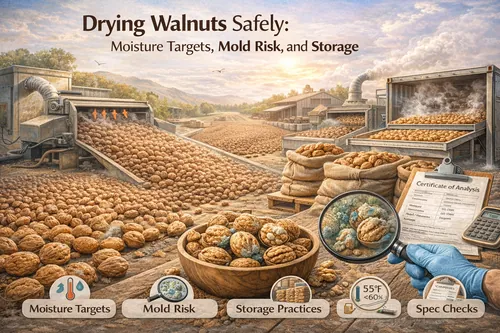
Drying is one of the biggest quality levers in walnuts. Hitting the right moisture target reduces mold risk, protects color, and improves storage stability. This guide explains how drying fits into the harvest flow and what buyers should look for when qualifying bulk walnut programs.
Previous: Walnut Harvest Process: Shaking, Hulling, and Drying Flow • Next: Shelling and Sorting Walnuts: How Halves/Pieces Grades Are Produced
Related: bulk walnut products • products catalog • request a quote
Why drying targets matter (buyers’ view)
Moisture affects both safety and commercial quality. When walnuts are too wet, mold risk increases and defects can rise during storage. When they’re overdried or handled harshly, kernels can become brittle and breakage can increase—impacting grade yield and value.
- Food safety: lower moisture reduces the conditions that support mold growth.
- Quality retention: stable moisture helps protect color and flavor through storage and transit.
- Spec performance: moisture is a core COA and receiving checkpoint for most bulk programs.
Where drying sits in the field-to-warehouse flow
At a high level, walnut flow commonly looks like:
Orchard operations → harvest (shaking) → hulling (remove husk) → drying → (optional) shelling/sorting → warehousing
Drying is the bridge between “freshly harvested” and “warehouse-stable.” Delays or variability here can show up later as color drift, off-notes, or storage losses.
Moisture targets and what to confirm on specs
Export and long-shelf-life lanes benefit from clearer moisture definitions. Instead of “typical moisture,” buyers usually do better to specify:
- Target moisture and maximum allowed (the release limit).
- Sampling method and test basis (so COA and receiving results compare apples-to-apples).
- Lot definition (single lot vs blended-to-spec) to manage variability.
Practical buyer tip: If you’re shipping ocean freight or expecting long destination storage, treat moisture + packaging barrier as a combined control plan.
Mold risk: the common drivers buyers should watch
Mold risk is rarely one single mistake—it’s usually a chain of small issues (weather, harvest timing, delays, moisture variability, and storage humidity). When qualifying a program, ask for the controls that prevent “warm + wet + time.”
- Harvest timing and weather: wet conditions can raise risk if drying capacity is stressed.
- Time-to-dry: shorter delays after harvest reduce the window for problems.
- Moisture uniformity: “average moisture” can hide wet pockets that become defects later.
- Warehouse humidity control: storage conditions matter even after good drying.
Storage, oxidation, and transit stability
Once walnuts are dried, storage conditions become the next major driver of shelf-life performance—especially oxidation/rancidity risk. Moisture and humidity interact with temperature and oxygen exposure.
- Temperature: higher temps accelerate quality loss; cooler storage helps preserve flavor.
- Humidity + oxygen: good barriers and clean warehouse practices support longer stability.
- Packaging alignment: liners/seals and pallet protection can matter more for export lanes.
Quality checkpoints that connect to procurement specs
Buyers typically link drying performance to receiving and COA fields like:
- Moisture (target/max), plus any destination-specific requirements.
- Mold-related defects (as defined by your program’s defect limits).
- Foreign material controls (especially important in field-to-plant transitions).
- Grade readiness (breakage sensitivity can influence halves/pieces yields downstream).
How to use this knowledge in buying decisions
If you’re qualifying a new walnut lane (new origin, new crop year, or new export market), use drying and storage questions to de-risk the first shipment:
- Ask for moisture targets/max and how lots are sampled/tested.
- Confirm warehouse conditions and packaging barrier approach for your transit lane.
- Align documentation (COA fields, defect definitions) before booking freight.
Next step
If you share your destination lane and format (in-shell vs kernels; halves/pieces), we can recommend the key moisture and storage checkpoints to include in your spec, plus packaging options that match your shelf-life and transit time. Use Request a Quote or email info@almondsandwalnuts.com.