
Almonds • In-shell (natural) • Quote-ready specs

Bulk In-Shell Almonds (Natural)

Atlas Nut Supply, LLC supplies bulk in-shell almonds (natural shell appearance) to manufacturers, brands, and distributors. We cooperate with multiple California suppliers to align the right grade, size/count, shell integrity, packaging, documentation, and delivery lane for your procurement.

Common use cases include retail/gift programs, cracking operations, and export demand for natural-shell presentation. If you require a specific shell type (soft/semi-soft vs hard) or a destination-specific presentation standard, include it in your request.

Format
In-shell almonds (natural)
Programs
U.S. + global export
Support
COA • traceability • docs

Request a quote Read applications Back to catalog

Fastest quoting: share grade (if specified), size/thickness (or count sizing), desired shell appearance (natural/unbleached), pack size, volume, and destination (and port if export).
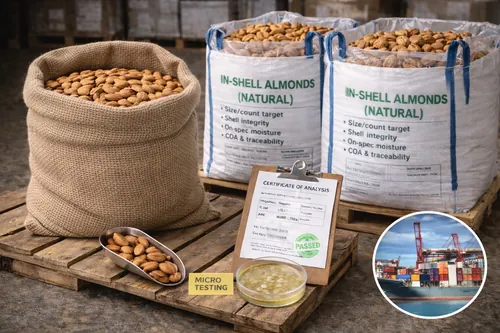
Bulk In-Shell Almonds (Natural) for wholesale supply — Atlas Nut Supply

In-shell almonds (natural) options

Common program variables (availability varies by season and supplier program):

  • Grade programs: buyer-specified U.S. grade (U.S. No. 1 / U.S. No. 2 / Mixed) or export class alignment
  • Sizing: minimum thickness, diameter screening, or count/weight sizing (export programs)
  • Natural shell appearance: specify natural/unbleached; confirm destination presentation rules
  • Shell integrity targets: broken shells, discoloration, adhering hull, foreign material tolerances
  • Food safety: validated treatment/pasteurization options where required by program or destination
  • Packaging: bulk bags/cartons; pallet constraints; container export options
  • Traceability + COA available per supplier program

Industrial applications

Typical manufacturing and ingredient uses:

  • Retail and gift programs (program dependent)
  • Cracking operations (kernel recovery programs)
  • Export lanes for in-shell demand
  • Seasonal promotions and mixed assortments

For deeper application guides, see the Atlas Nut Academy.

Product specifications (buyer-facing)

Use this as a quick RFQ reference. Exact limits and test methods vary by supplier program, crop year, and destination.

Specification Typical reference / how buyers specify
Product In-shell almonds (natural shell appearance / unbleached)
Botanical Almond (Prunus dulcis)
Grade / class Commonly specified as U.S. grade (U.S. No. 1, U.S. No. 2, or “Mixed” where varieties are mixed) or export class alignment as required.
Size / sizing method Specify sizing method: minimum thickness, diameter screening, or count/weight (e.g., number per 1000g or per lb). If you have a target screen or count range, include it.
Minimum thickness (reference) Some grade references use a default minimum thickness requirement unless otherwise specified (confirm your program/spec).
Moisture (handling) In-shell programs specify moisture limits and handling targets by destination/spec. Storage guidance often focuses on keeping almonds dry and stable to protect quality.
Shell integrity Buyer-defined tolerance for broken shells, discoloration, adhering hull, cracks, and foreign material (often grade-based).
Kernel condition Well dried; free from decay and rancidity; free from damage caused by insects/mold; no live insects inside the shell (common grade expectation).
Allergens Tree nut allergen. If you are packing consumer units, confirm required allergen and caution labeling for your market.
Packaging Bulk bags or solid containers; common export/bulk formats include sacks and cartons. Palletization and container loading set per lane.
Documentation COA, lot/traceability, country of origin, crop year (often requested for export), and destination-specific compliance documents on request (program dependent).

Natural shell note: If you require strictly unbleached shells, state “natural/unbleached only.” Some trade standards allow shell brushing/bleaching provided kernel quality is not affected and destination rules allow it.

Export planning: Share destination country + port, desired pack format, and required ship/arrival window so we can align lane feasibility and documentation.

Grades & tolerances (how buyers specify)

Many buyers reference U.S. in-shell grade language and then add tighter “house tolerances” for their use case (retail appearance vs cracking yield). If you have a spec sheet, send it—we’ll align the closest matching program.

Common U.S. grade structure

  • U.S. No. 1: clean shells; fairly bright and uniform; kernels well dried, free from decay/rancidity and major damage
  • U.S. No. 1 Mixed: same as U.S. No. 1, except two or more varieties are mixed
  • U.S. No. 2: same as U.S. No. 1 with additional tolerance for shell discoloration

For retail/gift programs, buyers often tighten shell appearance limits (uniformity, discoloration, adhering hull). For cracking operations, buyers often emphasize shell integrity + internal defect limits.

Typical tolerance categories buyers set

  • Loose extraneous/foreign material: define max by weight (and “fine” material via screen, if used)
  • External (shell) defects: broken shells, discoloration, adhering hull, and similar appearance defects
  • Internal (kernel) defects: decay/rancidity, insect/mold damage, serious damage limits
  • Variety mix: allowed dissimilar varieties and any “bitter” tolerance
  • No live insects inside the shell (common requirement)

If you require third-party inspection criteria or a destination standard, attach it with your inquiry.

Sizing guide (practical RFQ language)

In-shell sizing is specified differently across lanes. Some U.S. references use a minimum thickness requirement unless otherwise specified, while export programs often size by diameter screens or by count per unit weight.

Sizing approach How to specify
Minimum thickness Specify a minimum thickness requirement (or accept the program default). If you need a tighter minimum for retail presentation, state the exact minimum.
Diameter screening Specify screen sizing by maximum diameter of the equatorial section using round-holed or elongated screens (common export approach).
Count / weight Specify the number of in-shell almonds per 1000 g or per lb/oz (common export approach when screen tables differ by origin).

Best practice: include your target sizing method + acceptable tolerance (e.g., “count per kg ±X%” or “screen size + size tolerance”).

Food safety, pasteurization & microbiology

Food safety requirements vary by destination and customer standard. Many California/U.S. programs use validated treatment processes designed to achieve a minimum Salmonella reduction. If your product is for further processing, tell us your intended kill-step and verification plan.

How buyers typically specify

  • Micro targets: specify your pathogen indicator requirements and sampling plan (if any)
  • Treatment: request pasteurized/treated programs where required (state “validated kill-step” or equivalent wording)
  • Documentation: COA plus any required statements/certifications for your customer or destination
  • Allergen controls: tree nut allergen handling and cross-contact expectations

If you need “raw” label guidance, destination rules may differ—share your market and label requirements.

What to include for quote-ready alignment

  • Destination: country + port (import rules can drive treatment/documentation)
  • End use: retail, cracking, ingredient, or further processing
  • Hold time: expected shelf-life in your supply chain (impacts packaging/storage guidance)
  • Verification needs: COA format, lot coding, and traceability fields

If you share your micro spec, we’ll recommend the most practical program options and documentation package.

Packaging & logistics (bulk + export)

Packaging affects handling speed, cleanliness, and moisture stability during long transit. Tell us your receiving constraints (pallet height, forklift entry, container loading, and warehouse restrictions).

Common pack formats

  • Bulk bags (sacks) for in-shell programs
  • Solid containers (cartons, bins, or similar) when required by lane or warehouse standard
  • Labeling: lot code, crop year, grade/class, sizing (if sized), and destination language as required
  • Palletization: stretch wrap, corner boards, and export-ready pallet specs (lane dependent)

If you need a specific outer pack, tell us: “bags inside cartons,” carton count per pallet, and max pallet height/weight.

Export lane checklist

  • Destination + port: and any inspection/clearance requirements
  • Incoterms (if applicable): EXW/FOB/CIF/etc.
  • Timeline: required ship date and/or arrival date
  • Documents: COO, phytosanitary or destination-specific documents (as required)
  • Transit risk: temperature swings and condensation management for long lanes

Long lanes: share transit duration + destination climate so we can recommend practical moisture/temperature handling notes.

Storage & shelf-life guidance

In-shell almonds are sensitive to moisture pickup, heat, and strong odors. Good storage protects quality and helps reduce rancidity risk.

Best practices (warehouse-friendly)

  • Cool + dry storage; avoid temperature swings that cause condensation
  • Keep sealed between uses; limit exposure to humid air
  • Odor control: do not store/ship near onions, garlic, fish, chemicals, or other odiferous products
  • Pest control: keep product off the floor, use clean pallets, and follow your IPM program

Shelf-life planning inputs

  • Target conditions: cool temperature and controlled humidity help maintain quality
  • Moisture stability: keeping moisture low supports texture and slows quality loss
  • Packaging matters: moisture and oxygen barriers can improve stability depending on your lane

Share your storage temperature, humidity (if known), and expected hold time—we’ll suggest practical packaging/handling targets.

Specs checklist (quote-ready)

Send your spec sheet if you have one. Otherwise, start here for faster alignment.

  • Product: In-shell almonds (natural / unbleached shell appearance)
  • Grade target: U.S. No. 1 / U.S. No. 2 / Mixed (or your internal grade spec)
  • Sizing method: thickness minimum, diameter screen size, or count/weight sizing + tolerance
  • Shell integrity: broken shells, discoloration, adhering hull, cracks, foreign material tolerance
  • Internal defects: decay/rancidity, insect/mold damage limits; “no live insects inside shell” requirement
  • Moisture + storage expectations: your target + any destination method requirements
  • Food safety: micro targets and treatment/pasteurization requirement (if applicable)
  • Packaging: bags/cartons/containers + pallet constraints; container loading requirements (if export)
  • Volume: first order + forecast cadence
  • Destination: city/state/country (and port if export)
  • Delivery window: required ship/receipt dates
  • Documentation: COA, traceability/COO, crop year (if needed), certifications if required

Share end use (retail vs cracking vs export), and we’ll help confirm the right grade/sizing method and packaging targets for performance and shelf-life.

FAQ: In-shell almonds (natural)

What specs do you need to quote bulk in-shell almonds (natural)?

At minimum: grade (if specified), sizing method (thickness/screen/count), packaging, volume, destination/port, and timeline. Add shell integrity and internal defect tolerances plus documentation needs for faster alignment.

Can you supply pasteurized almonds for specific micro targets?

Yes. Share your micro requirements and destination rules, and specify whether you need a validated treatment/pasteurization program. We’ll align the right supply option and documentation package.

Do you ship in-shell almonds (natural) outside the United States?

Yes. We support export lanes depending on destination, volume, and required documentation. Share the country/port and timeline for planning.

Can you provide COA and traceability documentation?

Yes. COA and traceability documentation are available per supplier program. If you require certifications or destination-specific documents, note them in your inquiry.

How should in-shell almonds (natural) be stored for best shelf-life?

Keep sealed, cool, and dry, protected from heat, humidity, and strong odors. Avoid temperature swings to reduce condensation risk. Share your storage conditions and hold time for more specific guidance.