
Water Management in Walnuts: Yield, Size, and Defect Impacts
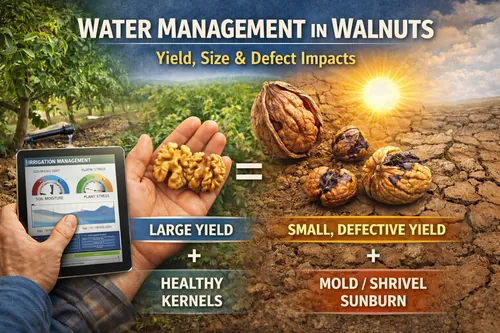
California walnut crop & harvest guide: how water management (irrigation timing, water stress, and late-season decisions) can influence yield, kernel size and fill, and defect risk. Also connects orchard outcomes to drying, storage stability, and procurement planning for bulk walnut programs.
Previous: Walnut Orchard Management Basics: What Influences Kernel Quality • Next: Pests and Diseases in California Walnuts: Quality and Food Safety Notes
Related: bulk walnut products • products catalog • request a quote
Why water management matters to buyers
Water management shapes how walnuts finish the season: how well kernels fill, how consistent sizes are, and how resilient the crop is to heat and disease pressure. For buyers, these orchard outcomes show up as: size distribution shifts, grade/defect variation, and sometimes drying and storage risk.
- Commercial impact: more small sizes or more defect sorting can tighten availability or change pricing.
- Quality impact: stressed or unevenly finished lots may show more variability in appearance and performance.
- Operations impact: moisture variability can complicate drying and storage posture.
Where water decisions show up in the crop outcome
Buyers don’t need orchard-level detail, but it helps to know what “water-managed” outcomes typically look like. In general, walnuts respond to water availability across the season; the timing of stress often matters as much as the magnitude.
1) Yield and size distribution
When water is limited or inconsistent, trees may produce a higher share of smaller nuts and kernels. Even when total yield holds, the distribution across sizes can shift, which impacts what’s available for specific pack styles and grades.
2) Kernel fill and texture (shrink/shrivel risk)
Under-watering or late-season stress can contribute to less complete kernel fill and higher shrivel incidence. This tends to matter most for buyers who specify appearance, piece integrity, or tight defect tolerances.
3) Defect pressure and variability
Water interacts with heat and orchard conditions. High heat plus stress can raise quality risk, while excessive or poorly timed water can elevate disease pressure. The buyer-facing outcome is often more sorting and greater lot-to-lot variability.
Connection to harvest moisture, drying, and storage
Water management can influence moisture conditions going into harvest. Lots with higher or more uneven moisture can:
- take longer to dry (potentially tightening throughput windows),
- increase mold risk if drying is delayed or uneven,
- increase storage sensitivity if moisture targets are not achieved consistently.
Procurement takeaway: if your program is shelf-life sensitive (snacks, toppings, premium bakery), ask how drying and storage posture are controlled—especially in variable years.
How to use this knowledge in buying decisions
When to build spec buffers
- If you need a tight size distribution (e.g., halves or large pieces), ask about expected size mix and plan alternates.
- If you run appearance-sensitive SKUs, align on defect and color expectations early—don’t wait until receiving.
When to request tighter controls
- Moisture target + storage posture: define what “safe and stable” means for your receiving and shelf-life model.
- Lot consistency: if you’re blending into finished products, ask about lot size and consistency controls.
- Documentation timing: request COA and key program documents early to avoid launch delays.
Buyer questions that reduce surprises
- What is the expected size/grade mix for this crop window? (and how much lot-to-lot variability should we expect?)
- How are drying targets controlled? (and what happens if moisture is uneven?)
- What defects are most common this season? (and how are they managed in sorting/grading?)
- What storage posture is used pre-ship? temperature/humidity practices that protect shelf life.
Next step
If you share your walnut format (halves/pieces, light/amber targets, moisture posture, packaging preference), destination, and timeline, we can outline common spec targets and the most reliable supply lane for your use case. Use Request a Quote or email info@almondsandwalnuts.com.