
Using Almond Pieces in Bakery Fillings: Migration Control and Texture
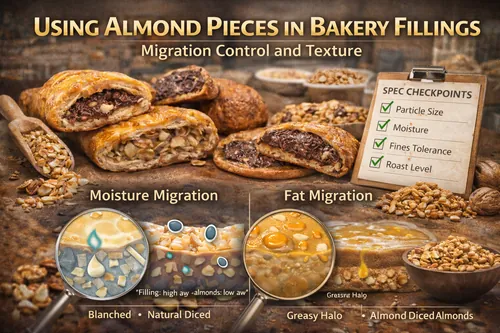
Industrial guide to using almond pieces in bakery fillings: moisture and fat migration control, crunch retention, and texture engineering. Covers almond piece format selection (cut size, blanching, roast profile), buyer spec checklist, processing and shelf-life notes, packaging and receiving guidance, and troubleshooting for common filling defects.
Previous: Almond Oil Roasting Programs: Oil Management, Seasoning Adhesion, and QA • Next: Almond-Based Sauces and Spreads: Emulsions, Particle Size, and Heat Stability
Related: bulk almond products • products catalog • request a quote
Quick takeaways for bakery teams:
1) Almond pieces soften primarily from moisture migration (water activity gradient), not “age” alone.
2) Piece size is a tradeoff: smaller = smoother distribution, larger = stronger crunch cue, but migration behavior differs.
3) Fat-rich fillings can still cause quality drift through fat migration (greasy halos, bloom, or soft crumb zones).
4) The fastest way to stabilize texture is to align filling matrix (aw, solids, fat phase) + almond piece spec + process temperature history.
Where almond pieces fit in bakery fillings
Almond pieces are used in fillings when you want visible identity, recognizable bite, and a premium “real nut” cue without the handling complexity of whole kernels. Compared with almond flour or almond butter, pieces provide a stronger texture signal, but they also introduce new stability challenges: migration, softening, breakage, segregation, and depositor clogs.
Examples: where almond pieces are commonly used
- Filled cookies and bars: nutty bite in caramel, chocolate, or fruit systems.
- Pastry fillings: frangipane-style systems, almond creams, and layered inclusions.
- Cakes and muffins: inclusion in batter-adjacent fillings, swirls, and ribbons.
- RTE bakery snacks: fillings where crunch perception differentiates SKU tiers.
- Co-extruded products: where nozzle clearance and flow make cut control essential.
The practical question is not “Can almond pieces work?” but “What almond piece spec will hold texture for our target shelf life, without forcing line rework?”
Migration basics: moisture migration vs. fat migration
Bakery fillings evolve after production. Even when the product looks perfect at pack-out, gradients in water activity and fat mobility can drive texture change over days or weeks. Understanding the two main migration modes helps you choose the right countermeasures.
Moisture migration (water activity-driven)
Moisture migration occurs when there is a water activity gradient between components—typically from a higher-aw filling or cake crumb into a lower-aw inclusion (almond pieces). As almond pieces absorb moisture, they transition from crisp to leathery to soft. The same effect can occur in reverse if you have a very dry filling and a higher-moisture inclusion, but in bakery systems it’s most often the nut pieces that take on moisture.
- Primary symptom: crunch loss and soft bite.
- Secondary symptoms: filling thickening over time, uneven chew, or localized sogginess around inclusions.
- Fast diagnostic: compare texture at day 0 vs. day 7 at controlled temperature; track weight gain of a measured inclusion fraction if you want a simple quant method.
Fat migration (oil mobility-driven)
Fat migration is movement of oils/fats between phases. In fillings, this can show up as greasy halos, oil bleed, or softening of adjacent crumb layers. Fat migration is influenced by the melting profile of the fat system, temperature cycling in distribution, and whether the filling has enough solids structure to hold fat in place.
- Primary symptom: oily surface, greasy packaging, or “wet-looking” zones.
- Secondary symptoms: flavor flattening, reduced aroma impact, or changes in perceived sweetness and mouthfeel.
- Fast diagnostic: warm/cool cycling (within your distribution reality) and observe oiling-out or halo development.
What to remember: Moisture migration primarily destroys crunch. Fat migration often changes appearance and mouthfeel. Many “texture” complaints actually involve both—so solve the dominant one first, then validate the other under real storage conditions.
Almond piece format selection: cut style, blanching, roast level
Selecting almond pieces for fillings is about matching three things: visual identity (what the customer sees), texture trajectory (what happens over shelf life), and line performance (what happens in your equipment). Most failures happen when one of these is optimized at the expense of the others.
Blanched vs. natural almond pieces
- Blanched pieces: cleaner, uniform appearance; ideal for light-colored fillings and premium “clean label” visuals.
- Natural pieces: skin flecks create contrast and a rustic look; can be attractive in whole-grain or artisan-style SKUs.
Raw vs. roasted almond pieces
Roast level affects flavor and texture. Roasted pieces deliver stronger aroma and a more pronounced “nutty” note, but roast also changes surface oil expression and can alter how quickly pieces soften. Roast is not just “more flavor”—it’s a structural and stability variable.
- Light roast: balanced flavor, often better for delicate fillings where you want almond notes without dominant roast character.
- Medium roast: stronger aroma and color; can help “read” as almond at lower inclusion rates.
- Darker roast: intense flavor and darker color; risk of bitterness and higher perceived dryness in some fillings.
Cut styles used in fillings
- Chopped pieces: mixed size distribution; strong “real nut” look; needs tighter spec control to prevent fines and dust.
- Diced / controlled cut: more uniform behavior in dosing and texture; preferred for depositor reliability.
- Sliced (chips/flakes): strong visual but can fracture easily and soften quickly due to high surface area.
- Meal/flour blend (hybrid systems): pieces deliver crunch while meal improves body; useful when you need both structure and bite.
Procurement tip: For fillings, ask for a size distribution rather than a single nominal cut. A “controlled cut” with defined screen fractions often reduces both depositor clogs and batch-to-batch texture drift.
Size distribution: how it affects bite, migration, and line performance
In fillings, size distribution impacts three competing outcomes: (1) bite perception, (2) migration rate, and (3) depositor reliability. You rarely maximize all three without making conscious tradeoffs.
Smaller almond pieces (finer chops, small dice)
- Pros: even distribution, cleaner depositing, less nozzle interference, more consistent bite in every unit.
- Cons: higher surface area can accelerate moisture pickup (faster softening), and fines can thicken fillings or create pasty mouthfeel.
- Best for: thin-layer fillings, co-extrusion, or products where uniformity is critical.
Larger almond pieces (coarse chops, larger dice)
- Pros: stronger crunch cue and premium bite; can stand up better in some matrices if protected.
- Cons: higher risk of breakage during mixing, higher depositor clog risk, and potential segregation if viscosity is low.
- Best for: thick fillings, hand-assembled pastries, or premium SKUs where bite is a selling point.
The “hidden problem”: fines and dust
Fines (dust) matter because they behave like a thickener and can change the filling’s viscosity and water binding. They also increase the surface area available for moisture uptake, which can reduce crunch stability and shift the texture from “crunchy inclusions” to “nutty paste.”
Control lever: If you’re seeing unexpected thickening or pasty mouthfeel, don’t only blame the filling base. Check the almond piece spec for fines percentage and whether handling is generating breakage before the pieces enter the mixer.
Filling matrix design: controlling water activity and mobility
Almond pieces are only as stable as the matrix around them. If the filling has a high mobile water fraction, it will hydrate the pieces. If the fat phase is highly mobile and the structure is weak, oil can migrate and create greasy zones. The goal is to reduce mobility—without destroying eating quality or making the product hard to deposit.
Moisture migration controls (practical levers)
- Lower the filling’s water activity (aw): use solids, syrups, or humectant strategy appropriate for your formulation goals and labeling.
- Increase binding/structure: certain solids systems reduce free water and slow diffusion.
- Barrier strategy: in layered products, a barrier layer (fat-based or chocolate-based, depending on SKU) can reduce migration into pieces and crumb.
- Piece conditioning: ensure pieces are at stable moisture and temperature before use; avoid introducing warm, humid pieces into a low-aw filling.
Fat migration controls (practical levers)
- Stabilize the fat phase: choose a fat system with a melting profile that matches your distribution temperatures.
- Increase solids structure: a structured matrix reduces oil mobility and “bleed.”
- Avoid temperature cycling: cycling increases mobility and can trigger fat movement and appearance defects.
Important: The “right” aw target depends on your product category, texture target, and food safety plan. Align aw goals with QA and regulatory requirements for your finished product.
Processing steps that protect crunch
Even with the right almond piece spec, process conditions can destroy texture before the product ever reaches the shelf. The highest-risk steps are mixing (breakage), warm holding (migration acceleration), and depositing (shear + nozzle blockage).
Mixing: minimize breakage and fines generation
- Add pieces late: incorporate almond pieces after the filling base has been developed and cooled into its target viscosity window.
- Use gentler mixing: avoid long high-shear mixing that fractures pieces.
- Control batch temperature: warmer fillings speed up migration; too cold increases viscosity and can increase mechanical stress on pieces.
Holding and transfer: manage time and temperature
- Limit warm hold time: long warm holds accelerate both moisture and fat migration.
- Agitation strategy: excessive agitation can break pieces; insufficient agitation can lead to settling—match your viscosity and piece size.
- Transfer method: pumping can shear and fracture inclusions; define maximum inclusion size for your pump path.
Depositing: design for inclusion clearance
- Nozzle clearance: select piece size based on the smallest restriction in the depositor path.
- Viscosity window: too thin = segregation; too thick = clogs and piece fracture.
- Inline filtration: if used, ensure it doesn’t trap inclusions and cause pressure spikes.
Line KPI suggestion: Track depositor pressure (or fill time) vs. inclusion lot. If pressure spikes correlate with certain lots, investigate piece size distribution and fines percentage first.
Shelf-life and storage: keeping texture through distribution
Crunch retention is not only a formulation and ingredient question—it’s also a storage reality question. If your distribution chain includes warm periods or temperature cycling, migration accelerates. Your validation should reflect your real logistics.
What to validate during trials
- Day 0 vs. end-of-life texture: measure bite perception (sensory) and, if useful, objective crunch proxies.
- Warm/cool cycling: simulate your distribution profile to expose migration issues early.
- Package interaction: oily halos and grease staining can be packaging-dependent.
- Oxidation sensitivity: almonds can pick up oxidative notes over time—align packaging and oxygen exposure with your shelf-life target.
Note: Almond products are sensitive to oxidation; store bulk almonds and almond pieces in a cool, dry environment and protect from heat and prolonged oxygen exposure. Always align shelf-life targets with your internal QA program and customer requirements.
Packaging options for bulk almond pieces
Bulk almond pieces are typically packed for industrial use in lined cartons or bags, with pallet configurations designed for receiving and staging. Packaging impacts both quality (oxygen/moisture exposure) and operational efficiency (ease of handling, lot control, and sanitation).
Common packaging formats
- Lined cartons: common for chopped and diced pieces; good stackability and lot control.
- Multiwall bags with liners: used in some programs; confirm handling and re-close expectations.
- Bulk bags (where applicable): for high-volume users; confirm dust control and plant sanitation requirements.
Receiving details that prevent delays
- Define pallet footprint and stack height: match your warehouse constraints.
- Confirm lot coding visibility: make sure codes remain readable through your internal labeling process.
- Set storage conditions: stable cool storage supports both texture performance and sensory stability.
Format and spec checkpoints buyers should confirm
A buyer-ready spec sheet ensures the almond pieces you receive behave the same way in your filling every time. This is especially important when you scale production or qualify secondary supply lanes.
Identity and processing
- Type: almond pieces (chopped/diced/sliced), blanched or natural, raw or roasted.
- Roast profile (if roasted): light/medium/dark targets, plus sensory acceptance (bitterness limits, off-notes).
- Color/appearance: target range; define if pieces will be visible at the surface or only internal.
Cut/size distribution (critical for depositors)
- Nominal cut: diced size or chopped spec.
- Size distribution method: screen fractions (preferred for industrial programs).
- Fines/dust limit: define maximum acceptable fines and how measured.
- Overs limit: define maximum overs percentage to protect nozzles and pumps.
Quality and safety
- Moisture target: define acceptance range; stability is often more important than a single number.
- Defect limits: foreign material controls, defect tolerance, and color limits as needed.
- Micro requirements: define based on your category and internal program.
- Allergen statement: tree nut declaration and cross-contact statement as required.
Packaging and logistics
- Packaging: carton/bag format, liner type, net weight per unit, pallet configuration.
- Labeling: lot code format, pack date, country of origin statement needs.
- Storage: recommended storage conditions and maximum exposure limits for warm staging.
Operational shortcut: If you only add one new spec item, make it this: “Size distribution by screen analysis, including fines % and overs %.” That one line prevents many depositor and texture failures.
Troubleshooting: common defects and likely causes
When fillings drift, teams often blame the base. In reality, almond piece variation and process temperature history can be the dominant drivers. Use this table to triage quickly.
| Issue | Likely drivers | What to check first |
|---|---|---|
| Crunch loss / soft pieces | Moisture migration, high aw filling, warm holds, small pieces with high surface area | Filling aw strategy, hold time/temp, piece size distribution |
| Depositor clogs | Overs pieces, clumped inclusions, low clearance, viscosity too high | Overs % spec, nozzle clearance, inclusion mixing uniformity |
| Filling thickens unexpectedly | High fines %, moisture uptake, over-mixing causing breakage | Fines % on COA/spec, mixing profile, staging time |
| Greasy halo / oil bleed | Fat migration, weak structure, warm cycling | Distribution temperatures, fat phase stability, solids structure |
| Uneven inclusion distribution | Segregation from low viscosity, poor agitation, long hold | Viscosity window, agitation method, time between mixing and depositing |
How to request a quote with fewer back-and-forths
The fastest quotes happen when the supplier can match the right cut, the right packing line, and the right QC controls to your application. Use the template below to reduce RFQ cycles.
RFQ template (copy/paste):
Product: Almond pieces for bakery filling inclusion
Type: blanched / natural • raw / roasted (roast target: light/medium/dark)
Cut style: chopped / diced / sliced
Size distribution: screen fractions preferred • target: [ ] • overs max %: [ ] • fines max %: [ ]
Moisture target/range: [ ]
Micro requirements: [targets appropriate for your category]
Packaging: cartons/bags + liners • net weight per unit: [ ] • pallet config: [ ]
First order volume: [lbs/kg] • Annual forecast: [lbs/kg]
Destination: [city, state/country] • Incoterms (if applicable): [ ]
Timeline: sample by [date], first production by [date]
Documentation needed: COA, spec sheet, allergen statement, country of origin, other: [ ]
Notes: depositor/nozzle clearance, mixing method, expected inclusion rate (%), storage constraints: [ ]
FAQ
Do almond pieces need to be roasted before going into fillings?
Not always. Roasted pieces provide stronger aroma and flavor impact at the same inclusion rate, but roast can also change how pieces behave in fat-rich or high-aw systems. The best choice depends on your flavor target, color expectations, and how sensitive your filling is to migration and shelf-life drift.
How do we pick the “right” almond inclusion rate?
Start with the sensory target (how “almond-forward” the product should be) and the texture target (how often a consumer should encounter a piece). Then validate line performance: higher inclusion rates increase the risk of depositor issues and can accelerate texture drift if migration is not controlled.
What’s the quickest way to stabilize crunch without changing the whole recipe?
Tighten the almond piece spec (control overs and fines), add pieces later with gentler mixing, reduce warm hold time, and validate storage temperature stability. If crunch stability is still insufficient, revisit the filling aw strategy and consider barrier approaches in layered products.
Should we specify water activity for almond pieces?
Many programs focus on moisture and size distribution first, but if your product is highly sensitive to crunch retention, agreeing on a stable incoming moisture target and validating behavior in your finished product can be more meaningful than a single number on paper.
Next step
If you share your bakery filling type (fat-based, syrup-based, fruit-based, cream-style), inclusion rate, and depositor constraints, we can help confirm common almond piece specs (size distribution + fines/overs limits), packaging options, and the fastest supply lane. Use Request a Quote or email info@almondsandwalnuts.com.
Looking for more almond formats? See bulk almond products or browse the products catalog.