Orchard Irrigation and Water Stress in Almonds: Quality and Yield Impacts
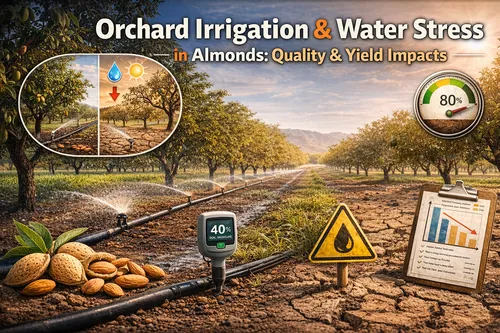
California almond crop & harvest guide: orchard irrigation and water stress are two of the biggest drivers of yield outcomes, kernel size distribution, harvest moisture variability, and storage stability. This deep-dive explains how water management decisions in the orchard translate into the quality signals buyers see later in grading, COA documentation, and receiving inspections.
Previous: Almond Bloom, Pollination, and Weather Risk: Why Crop Timing Matters • Next: Pest and Disease Pressure in California Almonds: What Affects Grade
Related: bulk almond products • products catalog • request a quote
Buyer focus: Irrigation and water stress are not just “grower topics.” They influence what matters to QA and procurement: kernel sizing and uniformity, moisture control, defect risk, shelf-life performance, and the likelihood of additional sorting or tighter sampling plans.
Table of contents
- Why irrigation and water stress matter to buyers
- What “water stress” means in an almond orchard
- Common almond irrigation systems and what they change
- Which growth stages are most sensitive to stress
- How water stress translates into quality and grade outcomes
- Harvest moisture, drying load, and storage stability
- Deficit irrigation: the idea, the benefits, and the risks
- How water status is monitored (and why it matters for consistency)
- Procurement and QA checklist for crop-year conversations
- FAQ: orchard irrigation and almond quality
- Next step
Why irrigation and water stress matter to buyers
In bulk nut procurement, buyers rarely see the orchard decisions directly. What you see is the “shadow” of those decisions: size distribution, breakage behavior, moisture variability, defect rates, and shelf-life performance. Irrigation is one of the most influential variables because it affects both how much the tree produces (yield) and how those nuts finish the season (maturity timing, kernel fill, hull and shell behavior).
When water is limited—or when irrigation is mistimed—orchards can produce almonds that are more variable. Variability is expensive: it often drives more aggressive sorting, tighter incoming sampling, higher rework risk, and more conservative storage plans. For manufacturers and ingredient users, that can mean formulation adjustments, line efficiency issues, or unexpected QA holds.
On the positive side, well-managed irrigation supports more uniform kernel development and predictable moisture management at harvest. That predictability is exactly what procurement teams want: consistent spec performance, stable sensory outcomes, and fewer surprises at receiving.
What “water stress” means in an almond orchard
Water stress is the mismatch between a tree’s water demand and the water it can access. Demand rises with sunny, hot, windy conditions and with increasing canopy size. Supply depends on irrigation volume and timing, soil water-holding capacity, root health, and distribution uniformity.
Importantly, “water stress” is not a single on/off condition. Trees can be slightly stressed (with minor impacts) or severely stressed (with major impacts), and the timing of stress can matter as much as the severity. A short stress event during a critical growth stage can reduce kernel size even if the orchard looks “fine” later.
Why orchard variability shows up in lots
Almond lots often blend nuts from multiple blocks, varieties, or harvest dates. If water status varied across a ranch (different soils, irrigation uniformity, or scheduling), you can see it later as uneven maturity and sizing. That can influence how evenly nuts dry and how stable they are in storage.
Common almond irrigation systems and what they change
California almond orchards commonly use micro-irrigation, including drip and micro-sprinkler systems. The system design influences how water is distributed, how roots develop, and how forgiving the orchard is to short scheduling errors.
Drip irrigation
Drip delivers water in a localized pattern. It can be efficient and precise, but it also means the orchard relies heavily on uniform emitter performance and consistent scheduling. If parts of a block have plugged emitters or uneven pressure, the water stress pattern can become “patchy”—and patchiness is a common driver of maturity variability.
Micro-sprinklers
Micro-sprinklers wet a broader soil area. This can support wider root distribution and can sometimes buffer short-term scheduling mistakes, depending on soil type. However, the broader wetting pattern can also increase weed pressure and evaporative losses in certain conditions. In practice, the best system is the one that is well-maintained and well-monitored for uniformity.
Why system maintenance matters to quality
From a buyer’s perspective, irrigation uniformity is a “quiet” risk factor. When irrigation distribution is uneven, the orchard produces mixed maturity levels and mixed kernel development. That mix can travel through the supply chain and show up as wider moisture spread in finished product, higher variability in roast performance, and inconsistent texture in applications that are sensitive to water activity and oxidation.
Which growth stages are most sensitive to water stress
Almond trees move through distinct seasonal stages: bloom and pollination, canopy expansion, nut set, kernel fill, hull split, harvest, and post-harvest recovery. Water stress can affect each stage differently, which is why “seasonal timing” is a critical part of crop-year context.
Bloom and early season establishment
Early-season water management supports canopy development and sets the baseline for photosynthesis capacity. While pollination is heavily influenced by weather, early stress can limit the tree’s ability to carry and develop nuts later, especially in shallow or sandy soils.
Kernel fill (the “size and weight” window)
Kernel fill is the period where the crop’s potential becomes physical kernel mass. Stress during this time is commonly associated with smaller kernel size, reduced kernel weight, and less uniformity. For buyers, this can mean shifts in size distribution and a greater chance that a lot spans a wider range of sizes than typical.
Hull split and maturity timing
Hull split is a critical operational window because it influences pest pressure, harvest timing, and the “evenness” of shake and pickup. Water status can shift the timing and uniformity of hull split. If the orchard experiences uneven hull split, harvest may require more passes, and lots can contain a wider range of maturity levels.
Post-harvest irrigation and next-year potential
Post-harvest water management helps trees rebuild reserves. Stress after harvest can reduce return bloom potential and may increase year-to-year yield variability. For procurement teams managing multi-year supply lanes, this matters: orchard recovery influences whether next season is likely to be stable or erratic.
How water stress translates into quality and grade outcomes
Buyers typically experience orchard conditions through a few measurable outcomes: size, moisture, defect rates, and shelf-life behavior. Water stress can touch each of those outcomes through multiple pathways. Below are the most practical, procurement-relevant connections.
1) Kernel size distribution and uniformity
A well-watered orchard generally supports more consistent kernel fill, resulting in a tighter size distribution. Stress tends to widen distribution: more small kernels, more variability, and occasionally more “mixed maturity” lots. In many industrial applications—especially where dosing and flow properties matter—uniformity is as important as the average size.
2) Shell and hull behavior that impacts harvest efficiency
Irrigation and stress can influence hull integrity and maturity timing. Operationally, if nuts do not mature evenly, harvest may be spread out, which can affect field exposure time and create variability in initial moisture and drying needs. The result may be a lot with a wider moisture range that requires tighter controls at receiving.
3) Defect risk: indirect but real
Water stress doesn’t automatically “cause” defects, but it can create conditions that increase risk:
- Insect dynamics: Stress timing can interact with pest pressure windows. If hull split timing shifts, exposure can change and variability can increase.
- Mold risk and hidden damage: Lots with uneven moisture or prolonged field exposure can have elevated quality-management needs. That typically shows up in stricter receiving inspections, more sorting, and tighter storage controls.
- Foreign material risk: Harvest logistics and multiple passes can increase handling complexity. More handling can mean more opportunities for foreign material unless controls are strong.
4) Grade outcomes and downstream sorting
Grade outcomes are influenced by multiple factors (variety, pests, weather, harvest handling), but irrigation-driven variability can make it harder for a lot to perform consistently through grading and sorting. That can affect yield into certain product cuts (whole, diced, sliced, blanched, etc.), depending on program and specification.
Practical buyer insight: If a crop year is known for water constraints in certain regions, buyers may want to plan for more variability—not necessarily “bad quality,” but wider distributions that benefit from clearer specs, earlier sampling, and storage conditions that reduce oxidation risk.
Harvest moisture, drying load, and storage stability
Moisture is one of the cleanest bridges between orchard/harvest conditions and warehouse performance. Even if two lots meet a moisture spec on paper, the distribution of moisture within the lot (how uniform it is) can influence how it behaves in storage and transit.
Why moisture uniformity matters
Lots with pockets of higher moisture can be more sensitive to storage conditions, especially if temperature and humidity are not tightly controlled. Even when the average is acceptable, unevenness can increase the need for careful warehouse management and can elevate the importance of packaging decisions (liners, barrier materials, pallet wrap practices, and container loading discipline).
Drying and handling: where variability can expand
Almonds are dried after harvest to reduce moisture to a level suitable for safe storage and shipping. If orchard maturity is uneven, or if harvest is spread out, the drying process has to manage more variability. Additional handling steps can also increase the emphasis on foreign material controls and receiving checks.
Storage stability and oxidation risk
Almond shelf life is influenced by temperature, oxygen exposure, and humidity. Water management ties in indirectly: lots that require more operational manipulation (additional drying management, extra sorting, more handling) benefit from a storage plan that is designed for the intended shelf life and destination transit time. In procurement terms, this is where packaging and warehouse practices become part of quality control.
If your use case is oxidation-sensitive (long distribution chain, warm climates, premium sensory targets), it is worth aligning your supplier program on packaging format, container loading approach, and warehouse conditions that reduce rancidity risk.
Deficit irrigation: the idea, the benefits, and the risks
“Deficit irrigation” broadly refers to intentionally applying less water than full crop evapotranspiration demand for a defined period. In practice, deficit strategies are used when water availability is constrained or when growers seek a specific agronomic outcome. Done carefully, certain deficit approaches can be part of a planned system. Done poorly—or forced by sudden water limitation—deficit irrigation can drive quality variability.
What deficit strategies try to manage
- Water allocation constraints: Limited supply requires prioritization of the most sensitive stages.
- Operational scheduling: Managing irrigation capacity during peak demand periods.
- Tree vigor control: In some contexts, controlling excessive vegetative growth can be a goal (program dependent).
Where deficit irrigation can raise buyer-relevant risks
If deficit stress overlaps with kernel fill, the biggest “buyer-visible” signal is often a shift toward smaller kernels and more variability. If it overlaps with hull split and harvest timing, the visible signals may include mixed maturity, more variable moisture, and a need for tighter receiving controls.
For procurement teams, the key is not to assume deficit irrigation equals poor product. The question is: Was stress planned, monitored, and timed to avoid critical quality windows? That’s a crop-year conversation worth having—especially for high-volume contracts.
How water status is monitored (and why it matters for consistency)
Modern orchards often combine weather-based estimates with field measurements. Buyers don’t need the agronomy details, but understanding the monitoring “stack” helps you interpret how consistent a supplier’s upstream production can be.
Common monitoring approaches
- Weather-based estimates: Using local weather data to estimate water demand and schedule irrigations accordingly.
- Soil moisture monitoring: Sensors or field checks that indicate whether the root zone is replenished and whether irrigation is reaching intended depths.
- Plant-based signals: Measurements or observations that reflect the tree’s actual water status (not just soil conditions).
- System performance checks: Distribution uniformity, pressure checks, filtration maintenance, and emitter inspection.
Why buyers should care about monitoring
Monitoring is a proxy for control. When water is constrained, a monitored and actively managed orchard is more likely to protect the most quality-sensitive stages and produce lots that behave predictably in hulling, sorting, and storage. Predictability is the foundation of a stable ingredient program.
Simple supplier question: “How did you monitor orchard water status during peak summer demand?” You’re not looking for a perfect answer—you’re looking for evidence of disciplined control.
Procurement and QA checklist for crop-year conversations
If you are buying bulk almonds as ingredients (whole, diced, sliced, blanched, meal/flour), orchard-level variability can show up differently depending on your process. Use the checklist below to connect irrigation-season context to what you actually need to manage.
Questions to ask suppliers (practical, non-technical)
- Crop-year context: Were there water constraints that affected timing or uniformity in your sourcing region?
- Harvest window: Was harvest concentrated or spread out? Did that change moisture variability management?
- Quality controls: What were the key checkpoints for moisture, foreign material, and defect sorting?
- Program control points: Which steps are in-house vs. handled by partner facilities (hulling/shelling/sorting/warehousing)?
- Documentation: What is typical for your program (COA, microbiology, allergen statements, country of origin, etc.)?
Spec and receiving implications
If you anticipate a crop-year with more variability, consider tightening how you operationalize specs:
- Moisture & water activity focus: Align targets and sampling intensity to your shelf-life needs and distribution chain.
- Size distribution clarity: If your process is size-sensitive, define acceptable distributions rather than relying on a single nominal size callout.
- Defect tolerance alignment: Make sure internal QA tolerances match what the supplier program can consistently deliver for your chosen product cut.
- Storage plan: Match packaging and warehouse conditions to transit time and climate exposure.
How this connects to product format decisions
Different formats respond differently to variability:
- Whole kernels: More sensitive to sizing and visual uniformity; can be sensitive to roast uniformity if moisture varies.
- Diced/sliced: Input kernel integrity and size distribution can influence yield and consistency of cut dimensions.
- Blanched: Peel removal behavior can be influenced by maturity and handling; program controls matter.
- Flour/meal: Still sensitive to oxidation and sensory stability; storage and packaging become especially important.
For current options and typical formats, see our bulk almond products page or browse the full products catalog.
Quality checkpoints that connect to procurement specs
Buyers often assess quality through a blend of supplier documentation and internal receiving checks. While exact line items vary by program and product, the concepts are consistent: moisture management, foreign material controls, defect sorting, and storage practices that protect shelf life.
From a risk-management perspective, irrigation and water stress matter because they can increase variability. Variability drives the need for stronger checkpoints—more consistent sampling, clearer spec definitions, and storage plans that reduce the impact of moisture pockets or oxidation conditions.
Key steps in the field-to-warehouse flow
At a high level: orchard management → bloom/pollination → growing season conditions (including irrigation and stress) → harvest operations → drying → hulling/shelling (program dependent) → sorting/grading → warehousing → shipment. Each step can either preserve uniformity or amplify variability.
If your procurement program requires tight consistency, the strongest results typically come from suppliers who can describe control points across this entire chain—especially moisture management and warehousing.
Storage, oxidation, and logistics
Even with good harvest quality, storage and logistics determine how that quality arrives. Temperature, humidity, and oxygen exposure are major drivers of oxidation/rancidity risk. Lots with wider moisture distribution can be more sensitive to less-than-ideal storage conditions.
Practical ways buyers reduce risk include: selecting packaging that matches shelf-life targets, using warehouses with disciplined humidity control, planning shipments to avoid prolonged exposure to heat, and aligning receiving checks with the crop-year’s expected variability.
How to use this knowledge in buying decisions
If you are qualifying supply for a new SKU, align crop-year timing with launch plans and validate documentation early. If you are buying for an established program, use irrigation-season context to decide whether you need: tighter specs, higher sampling frequency, different packaging, or a more conservative shelf-life plan.
When in doubt, treat variability as a planning input rather than a surprise: define what “acceptable” looks like for your process, and select a supplier program that can consistently hit that target.
FAQ: orchard irrigation and almond quality
Does more irrigation always mean better quality?
Not necessarily. The goal is appropriate and timely irrigation that meets the orchard’s demand without creating other issues. Over- or under-watering can both create operational complications. For buyers, the key signal is consistency: uniform maturity, manageable moisture, and stable storage performance.
Can water stress affect almond taste?
Sensory outcomes are influenced by multiple factors (variety, maturity, storage conditions, oxidation), but orchard stress can indirectly influence the starting point by affecting maturity uniformity and downstream storage behavior. Most buyer-visible “taste problems” are ultimately tied to oxidation and storage conditions, which become more important when lots are more variable.
What’s the simplest crop-year indicator buyers should pay attention to?
Ask about variability: Was the season uniform, or did water constraints and heat events create uneven maturity or moisture challenges? That single conversation can help you decide how conservative your receiving and storage plan should be.
How does this topic relate to walnut sourcing?
Water management affects many tree nuts, but each crop has different sensitivity windows. If you buy both almonds and walnuts, it helps to treat “crop-year context” as a standard part of your supplier qualification. Explore our bulk almonds & walnuts overview for category-level guidance.
Next step
If you share your application and the format you need, we can confirm common spec targets, packaging options, and the fastest supply lane. Use Request a Quote or email info@almondsandwalnuts.com.
Helpful details to include: product format (raw/roasted/whole/diced/sliced/flour/oil), target specs, packaging, monthly volume, destination, and timeline.
Quick links: bulk almond products • products catalog • contact