
Almond Ingredients for Ice Cream and Frozen Desserts: Preventing Graininess
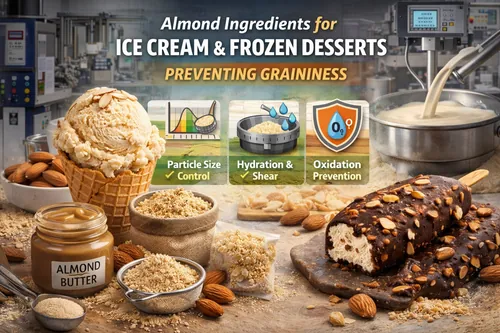
Grainy, gritty, or sandy texture is one of the most common failure modes when formulating almond-forward ice cream and frozen desserts. In production, the fix usually comes from format choice, particle size distribution, and dispersion + hydration control—not from “more flavor.” This guide explains what to specify when buying almond ingredients so your line hits smoothness targets reliably.
Previous: Almonds in Plant-Based Dairy: Base Building, Solids, and Stabilization Notes • Next: Almonds in Chocolate and Enrobing Lines: Moisture, Bloom Risk, and Inclusion Prep
Related: bulk almond products • products catalog • request a quote
Where graininess comes from in almond frozen systems
“Grainy” can mean different things to different QA teams. In almond frozen desserts it typically shows up as:
- Undermilled particles: a coarse tail in the particle-size distribution that reads as grit on the tongue.
- Incomplete dispersion: clumps or “wet sand” texture from poor wet-out of powders or pastes.
- Hydration mismatch: proteins/fibers binding water unevenly and creating a chalky or sandy mouthfeel.
- Process sensitivity: insufficient shear/homogenization, or adding almond ingredients at the wrong step.
Practical rule: if graininess appears immediately, it’s usually particle size/dispersion. If it worsens over shelf life, investigate hydration/stabilizer balance and storage/temperature cycling.
Choose the right almond format for smoothness
The “best” almond ingredient depends on whether you need flavor, fat, solids, or inclusions. For smooth bases, prioritize formats designed for fine dispersion:
- Almond butter / paste: strong flavor and fat contribution; specify grind/fineness and oil management to avoid separation.
- Almond flour / meal: boosts solids; requires tighter particle control to prevent sandy mouthfeel; manage a “coarse tail.”
- Defatted almond protein powder: improves protein/label; can read chalky if hydration is rushed or particle distribution is broad.
- Roasted inclusions (pieces, diced): for texture contrast, not base smoothness; specify cut + fines to avoid dusty texture in the mix.
Buyer tip: if your goal is “extra creamy almond,” don’t force coarse flour into the base—use paste/butter (or a finer milled ingredient) and treat pieces as inclusions added later.
Spec checkpoints that directly reduce graininess
If you only tighten a few specs, make them the ones that correlate most strongly with smoothness in frozen systems:
- Particle size distribution: don’t just ask for “fine.” Ask for a defined distribution or sieve/mesh spec and a limit on coarse fraction.
- Fines / dust (for pieces): excess fines can create a dry, dusty mouthfeel and complicate dosing; set a fines limit.
- Moisture target: stability and flow; too high increases clumping risk; too low can increase dustiness in powders.
- Roast profile (if roasted): flavor consistency, color, and oxidation risk management.
- Sensory expectations: define “clean/nutty” vs “toasted,” and agree on off-notes thresholds.
- Micro requirements: align to your category and pasteurization approach.
Processing notes: where plants usually win or lose texture
Most graininess complaints trace back to when and how almond ingredients are introduced:
- Powder wet-out: add into a high-shear zone (or pre-slurry) to prevent fisheyes and clumps.
- Hydration time: give proteins/fibers time to hydrate before freezing; rushed processing can lock in chalky texture.
- Homogenization: pastes/butters generally benefit from adequate shear to reduce perceived particle and improve emulsification.
- Heat step placement: confirm whether the almond ingredient is added before/after pasteurization based on your program and desired flavor.
If you can only change one thing on the line: tighten dispersion (pre-slurry + shear) before you add “more stabilizer.” Stabilizers can hide issues but rarely fix an undermilled/coarse particle problem.
Shelf-life and oxidation considerations
Almond ingredients are oxidation-sensitive; off-notes can show up as “stale,” “cardboard,” or “painty” late in shelf life, especially in fat-containing systems. Align your risk posture with storage and packaging choices.
- Storage: cool, stable conditions; avoid temperature cycling that can stress emulsions and texture.
- Oxygen exposure: minimize open time; reseal promptly; manage headspace where applicable.
- Incoming checks: quick odor/sensory checks at receiving help catch oxidation early.
Packaging options for bulk programs
Packaging should support flow, cleanliness, and oxidation control for your format:
- Powders/flours: lined bags/cartons with consistent palletization; confirm receiving constraints and re-pack needs.
- Butters/pastes: pails, drums, or totes; confirm temperature handling and mixing expectations at point-of-use.
- Inclusions: cartons/bags with defined cut and fines control; avoid breakage from rough handling.
How to request a quote with fewer back-and-forths
To get an accurate offer quickly, send:
- Application: ice cream, gelato, frozen dessert, novelty, plant-based, or dairy
- Role in formula: base (smoothness critical) vs inclusion (texture intentional)
- Format: butter/paste, flour/meal, protein powder, diced/pieces
- Texture targets: “no graininess” + your particle size / sieve spec and coarse fraction limit (if you have one)
- Roast: raw vs roasted + flavor/color expectation
- Moisture target: and flow/handling constraints
- Packaging: bag/carton vs pail/drum/tote + pallet/receiving constraints
- Volume: first order + annual forecast
- Destination & timeline: ship-to + required ship/arrival window
- Documentation: COA, micro, allergen, COO, certifications as needed
If graininess is a known pain point, include: “CTQ = tight particle distribution + low coarse fraction + dispersion-friendly handling.” It helps align the program to the right mill/QA lane.
Next step
If you share your frozen dessert type and whether almonds are used in the base or as an inclusion, we can recommend a practical format and spec set (particle distribution, moisture, packaging) that reduces graininess risk. Use Request a Quote or email info@almondsandwalnuts.com.