
Almond Butter in Bulk: Viscosity Targets, Oil Separation, and Packaging
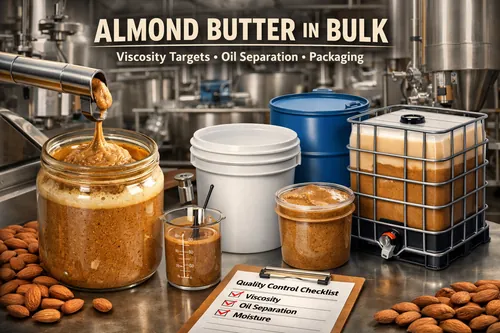
Bulk almond butter is a high-value ingredient, but it behaves more like a process fluid than a simple commodity. Performance on the line is usually decided by three linked variables: viscosity (how it pumps and fills), oil separation (how stable it stays through storage and handling), and packaging (how the product is protected and how you receive it). This extended guide shows how to spec a program that runs reliably at scale.
Previous: Diced Almonds as Inclusions in Bars and Snacks: Cut Size and Dispersion • Next: Defatted Almond Protein Powder for Nutrition Systems: Formulation and Handling
Related: bulk almond products • products catalog • request a quote
On this page
- Where bulk almond butter fits in production
- Natural vs stabilized: choosing the right program
- Viscosity targets: how to spec for pumping and filling
- Oil separation: what causes it and how to manage it
- Grind and particle strategy: smooth vs crunchy and how PSD matters
- Roast level and flavor: impact on viscosity, color, and stability
- Processing checkpoints: temperature, shear, and time-to-pack
- QA checkpoints: what to test and what to monitor
- Shelf-life and oxidation risk drivers
- Packaging options: pails, drums, totes/IBCs, and liners
- Receiving and storage guidance: prevent downtime and waste
- Troubleshooting guide: symptoms, causes, and fixes
- Specs checklist (quote-ready)
- FAQ
- Next step
Where bulk almond butter fits in production
Bulk almond butter shows up across multiple categories because it delivers flavor, fat, and solids in one ingredient. The “right” program depends on whether you use it as a primary base (nut-butter-forward SKUs) or as a functional component (texture and fat phase contributor in composite products).
Common industrial use cases
- Nutrition bars and snack bars: binder/fat phase contributor; impacts chew, tack, and shelf-life.
- Confectionery and fillings: pralines, creams, inclusions; viscosity must match depositor performance.
- Bakery systems: fillings, swirls, laminated applications; separation and viscosity control are key.
- Dairy-alternative bases: sauces, spreads, plant-based systems where emulsion stability matters.
- Foodservice sauces and dressings: pumpability and temperature behavior often drive the spec.
- Private label nut butter: finished product requires label strategy, separation expectations, and sensory consistency.
Practical rule: define the process constraint first (pump/fill/deposit/hand-apply), then lock the viscosity and separation program that matches it.
Natural vs stabilized: choosing the right program
“Natural” almond butter typically means ground almonds (and possibly salt) without stabilizers. This format commonly exhibits oil separation over time, especially when temperature fluctuates. Stabilized programs use approved stabilizers (program and market dependent) to reduce separation and maintain a more uniform texture during shelf-life.
Natural almond butter (separation expected)
- Often preferred for minimal-ingredient positioning
- Separation is managed via grind, temperature control, and handling
- May require mixing/recirculation during processing and before filling
- Best when you can control storage temperature and inventory turns
Stabilized almond butter (reduced separation)
- Better separation control for long distribution or warm lanes
- More forgiving in retail-ready formats
- Must align with label goals and customer requirements
- Still requires sensible temperature handling to protect texture
For industrial buyers, the decision often comes down to this: if oil separation creates real operational cost (rework, remixing, inconsistent deposits), stabilized programs can reduce risk. If label strategy is the top priority, natural programs can work well—provided you plan temperature control and handling.
Viscosity targets: how to spec for pumping and filling
Viscosity is the number buyers mention first, but it’s only meaningful if everyone measures it the same way. Almond butter is also strongly temperature-dependent—small temperature changes can cause large changes in pumpability.
Start with the “use-case viscosity” question
- Pumping/transfer: must move through your pump type and pipe size without excessive pressure or shear heating.
- Filling/depositing: must fill cleanly at your nozzle size, with acceptable tailing and weight control.
- Finished texture: must meet sensory expectations (spreadable vs firm; creamy vs thick).
- Inclusion suspension: if you add pieces (nuts, crisps), viscosity must prevent settling or separation during hold.
Spec viscosity like a manufacturing team
If you have a standard method, reference it in your spec sheet (temperature + method). If you don’t, you can still quote accurately by specifying required performance.
- Measurement temperature: define the temperature at which viscosity is evaluated (critical for comparability).
- Method alignment: specify the method you use or accept (e.g., rotational measurement with agreed conditions).
- Performance description: “pumpable at X temperature,” “deposits through Y nozzle,” or “fills at Z line speed.”
- Acceptable range: set a range, not a single number, to reduce false rejects while protecting performance.
Buyer tip: If you cannot share equipment details, share the failure mode. Example: “current product tails and smears in depositor” or “requires too much heat to pump.” That points directly to the right viscosity window.
Oil separation: what causes it and how to manage it
Oil separation is a natural outcome of a two-phase system: an oil phase and a solids phase. Over time, gravity and temperature changes can lead to oil rising and solids settling. This is more visible in natural programs, but even stabilized programs can show separation if storage is hot or cycling.
The main separation drivers in bulk handling
- Particle size distribution (PSD): finer particles can help create a more stable matrix, but may raise viscosity and clumping risk.
- Temperature history: heating and cooling cycles can change texture and accelerate separation.
- Hold time: long holds in tanks, totes, or drums allow phases to stratify.
- Shear and mixing: how the product is mixed or recirculated affects short-term stability before filling.
- Added ingredients: salt, sweeteners, cocoa, and inclusions can change viscosity and stability behavior.
How buyers reduce separation risk (operationally)
- Specify separation expectation: define what “acceptable” looks like (natural vs stabilized, storage window, and temperature).
- Plan receiving: decide whether you will warm, mix, or recirculate prior to use.
- Control storage temperature: stable, cool conditions reduce drift and stratification.
- Minimize open exposure: keep containers sealed; oxygen and moisture exposure can accelerate flavor drift.
Grind and particle strategy: smooth vs crunchy and how PSD matters
For almond butter, “smooth” and “crunchy” are not just consumer descriptors—they are manufacturing variables. Fine grind increases surface area and can increase viscosity. Coarse particles can reduce perceived smoothness and affect depositor performance.
Smooth programs
- Best for: depositing, pumping, confectionery fillings, uniform texture requirements.
- Watch-outs: very fine systems may be more oxidation-sensitive and can become too thick at lower temperatures.
- Spec note: if your equipment is sensitive, request tighter PSD control to reduce run-to-run variability.
Crunchy / inclusion programs
- Best for: texture-forward SKUs, inclusions, and products where visible pieces are desired.
- Watch-outs: pieces can settle in holding tanks; can clog nozzles; can cause weight variability.
- Spec note: define piece size range and inclusion percentage, plus your fill nozzle constraints.
Buyer tip: if you struggle with clogging or inconsistent weights, don’t just “raise viscosity.” Align PSD, inclusion size, and fill hardware so the product behaves predictably.
Roast level and flavor: impact on viscosity, color, and stability
Roast profile drives flavor and color, but it also changes how almond butter behaves. Roast can affect perceived thickness, color windows, and oxidation risk posture. If you use almond butter as a key flavor driver, roast consistency becomes a CTQ.
How to spec roast for industrial programs
- Flavor intent: light/nutty vs deeper/toasted; define the sensory direction.
- Color window: specify acceptable color range, especially if your finished product is light colored.
- Consistency: confirm how roast is controlled run-to-run (time/temperature, instrumentation, sampling cadence).
- Off-notes: bitterness or burnt notes can appear if roast control drifts; include sensory gates if critical.
Processing checkpoints: temperature, shear, and time-to-pack
Bulk almond butter performance is often won or lost after milling. Temperature control and how long the product sits before packing influence viscosity behavior, separation, and flavor stability. Buyers benefit from aligning their own process assumptions with how the supplier manufactures and packs.
Key process questions buyers should ask
- Temperature at pack: product temperature influences viscosity at filling and can change texture after cooling.
- Mixing/holding: how long does product hold, and is it mixed/recirculated before packing?
- Filtration/screening: if your process requires smoothness, confirm controls that remove large particles.
- Metal detection / foreign material control: align to your receiving and QA expectations.
- Time-to-seal: faster sealing reduces oxygen exposure (helpful for shelf-life stability).
Practical note: if you warm product to pump it, keep warming consistent and avoid repeated heating/cooling cycles—texture drift and separation tend to increase with cycling.
QA checkpoints: what to test and what to monitor
A strong bulk almond butter program combines in-process monitoring (to keep product consistent through a run) and finished-lot checks (to protect receiving specs). Your plan depends on category risk posture and whether the product is used as a primary ingredient or a minor inclusion.
Finished-lot items commonly requested (COA-style)
- Viscosity: method-aligned value or agreed performance statement
- Oil separation expectation: natural vs stabilized; storage window reference
- Moisture (and optionally aw): helps predict stability and microbial risk posture (program dependent)
- Color / sensory: roast consistency, off-note screening where appropriate
- Micro: as applicable to your category and customer requirements
- Allergen statement: required labeling and cross-contact notes
- Traceability: lot coding and documentation for recall readiness
Receiving-side checks that prevent downtime
- Packaging integrity: lids/liners intact; no leaks; no contamination at rim/seal.
- Temperature condition: note if product arrives unusually warm or cold (can predict pump behavior issues).
- Oil cap observation: note separation level on arrival; document with photos if outside expectation.
- Quick odor check: catches oxidation drift before it enters your process.
Shelf-life and oxidation risk drivers
Almond butter is sensitive to oxidation because it contains oil and has a large surface area of finely milled solids. The main risk drivers are oxygen exposure, heat, light, and time. Bulk handling adds risk if containers are opened repeatedly or if product spends time in warm staging areas.
- Storage: cool and stable; avoid temperature cycling and warm warehouses.
- Open-bin time: minimize exposure; reseal quickly; avoid repeated opening if possible.
- FIFO: align inventory turns to your flavor standard, not just a nominal best-by date.
- Transport: long, warm lanes can accelerate drift; packaging and temperature control matter.
If you see “mystery off-notes,” track the temperature history of the lot—heat exposure in transit or staging is a common driver.
Packaging options: pails, drums, totes/IBCs, and liners
Packaging is both a food-safety barrier and an operational decision. The “best” format matches your volume, receiving equipment, and how you will warm, pump, or scoop product. Discuss packaging early—changing formats later can add lead time.
Common bulk packaging formats
- Pails: flexible for smaller production runs and sampling; easier manual handling but more labor per unit volume.
- Drums: common for industrial programs; efficient for storage and export; compatible with drum handling equipment.
- Totes / IBCs: high-volume operations; efficient pumping/transfer; requires compatible pumps and handling equipment.
Liners and barrier expectations
- Barrier needs: higher barrier helps protect flavor over time and through warm transit.
- Compatibility: confirm liner compatibility with warming methods and pump/scoop systems.
- Headspace and sealing: sealing quality and headspace management affect oxygen exposure.
Share: receiving equipment, pallet footprint constraints, maximum pallet height, and whether you need to pump directly from the container.
Receiving and storage guidance: prevent downtime and waste
Bulk almond butter often fails operationally not because the product is “bad,” but because the receiving plan is mismatched to viscosity and separation behavior. A few simple decisions—warming method, mixing approach, and staging temperature—can eliminate most emergency rework.
Receiving checklist (practical)
- Document the lot: match lot code to COA and paperwork.
- Inspect packaging: liner integrity, rim cleanliness, seals, and evidence of leaks.
- Assess separation: observe oil cap; compare to your expectation for natural vs stabilized.
- Temperature note: record surface temperature if your process is sensitive to pumpability.
- Stage correctly: keep in stable conditions; avoid hot docks and sun exposure.
Storage guidance
- Stability beats “coldest possible”: stable temperatures often reduce texture drift better than inconsistent cooling.
- Keep sealed: reduce oxygen exposure; reseal immediately after partial use.
- Plan re-homogenization (if needed): natural programs may require mixing prior to use.
Troubleshooting guide: symptoms, causes, and fixes
Most bulk almond butter issues fall into a few buckets: viscosity mismatch, separation behavior, temperature handling, or particle/inclusion problems. Use the guide below to speed root-cause identification.
| Symptom | Likely causes | What to do (program dependent) |
|---|---|---|
| Too thick to pump | Temperature too low, viscosity window too high, PSD too fine | Warm consistently to a defined setpoint; adjust viscosity spec; request method-aligned viscosity range |
| Depositor tailing / smearing | Viscosity too low at fill temp, temperature drift, formulation differences | Tighten fill temperature control; spec viscosity at fill temperature; consider stabilized program if separation affects consistency |
| Excess oil cap / rapid separation | Natural separation, temperature cycling, long hold time, PSD shift | Stabilize storage temperature; mix/recirculate prior to use; adjust PSD; consider stabilized program if operationally costly |
| Clogging / nozzle blockage | Large particles or inclusions, insufficient screening, crunchy piece size too large | Define inclusion size range; confirm screening/controls; align nozzle size and fill hardware |
| Off-odor / rancid notes | Oxidation from heat/oxygen exposure, long warm transit, poor resealing | Improve storage stability; reduce open time; quarantine and document; align packaging barrier to lane risk |
Helpful supplier message: include symptom + temperature at failure, equipment type (pump/depositor), lot code, receiving date, and photos of separation. This speeds root-cause and prevents repeats.
Specs checklist (quote-ready)
If you have a spec sheet, send it. If not, this checklist usually gets to a quote with fewer back-and-forths:
- Product: Bulk almond butter (natural or stabilized)
- Roast profile: raw/light/medium/dark + flavor direction + color window (if critical)
- Texture: smooth or crunchy (if crunchy: inclusion % + piece size range)
- Viscosity target: method + temperature + acceptable range (or process requirement: pumpable/fill behavior)
- Oil separation expectation: acceptable oil cap over time at defined storage conditions (natural vs stabilized)
- Ingredients: salt level, sweeteners, cocoa, flavors (if applicable) + ownership of any customer-supplied inputs
- Micro: requirements aligned to your category and customer needs (as applicable)
- Allergen handling: statement language and cross-contact expectations
- Packaging: pails/drums/totes + liner/barrier expectations + pallet constraints
- Volume: first order + forecast; delivery cadence
- Destination: city/state/country; required delivery window; export documentation needs (if any)
- Documentation: COA, traceability, COO, certifications if required
If line performance is sensitive, include: “critical-to-quality = pumpability at ___°F/°C, depositor performance, and separation behavior during ___ days of storage.”
FAQ
Do I need a stabilized almond butter for foodservice?
Not always. If you can control storage temperature and you can mix prior to use, natural programs can perform well. Stabilized programs are often chosen when separation creates labor or quality risk, or when the distribution lane includes warm warehousing and long hold times.
What should I do if product arrives too firm?
First, check temperature at receiving and staging. Almond butter thickens significantly as temperature drops. If temperature is normal but product is still too firm, your viscosity window may be too high for your equipment or the PSD may be too fine—tighten the spec and align the measurement method.
Can I pump directly from drums or totes?
Yes, many plants do—if the viscosity window and temperature setpoints are aligned. Confirm how you will warm the product (if needed), what pump type you use, and whether you require a recirculation loop to keep the phase uniform.
How do I reduce oil separation without stabilizers?
Natural separation can be reduced (not eliminated) by using a tighter grind/PSD, controlling temperature stability, and minimizing long hold times without mixing. Define your acceptable separation window so the program can be built around it.
Next step
Share your application (bar system, filling, sauce, retail nut butter) and your process constraints (pump/depositor type, fill temperature, storage lane). We’ll confirm common spec targets, packaging options (pails/drums/totes), and the fastest supply lane. Use Request a Quote or email info@almondsandwalnuts.com.